
Jama Masjid, Delhi: Timings, Dress Code, the Minaret and a Visit Plan
Jama Masjid Delhi guide: visiting hours around prayer, entry and camera fees, dress code, the minaret climb, best time by month and a plan with Old Delhi.
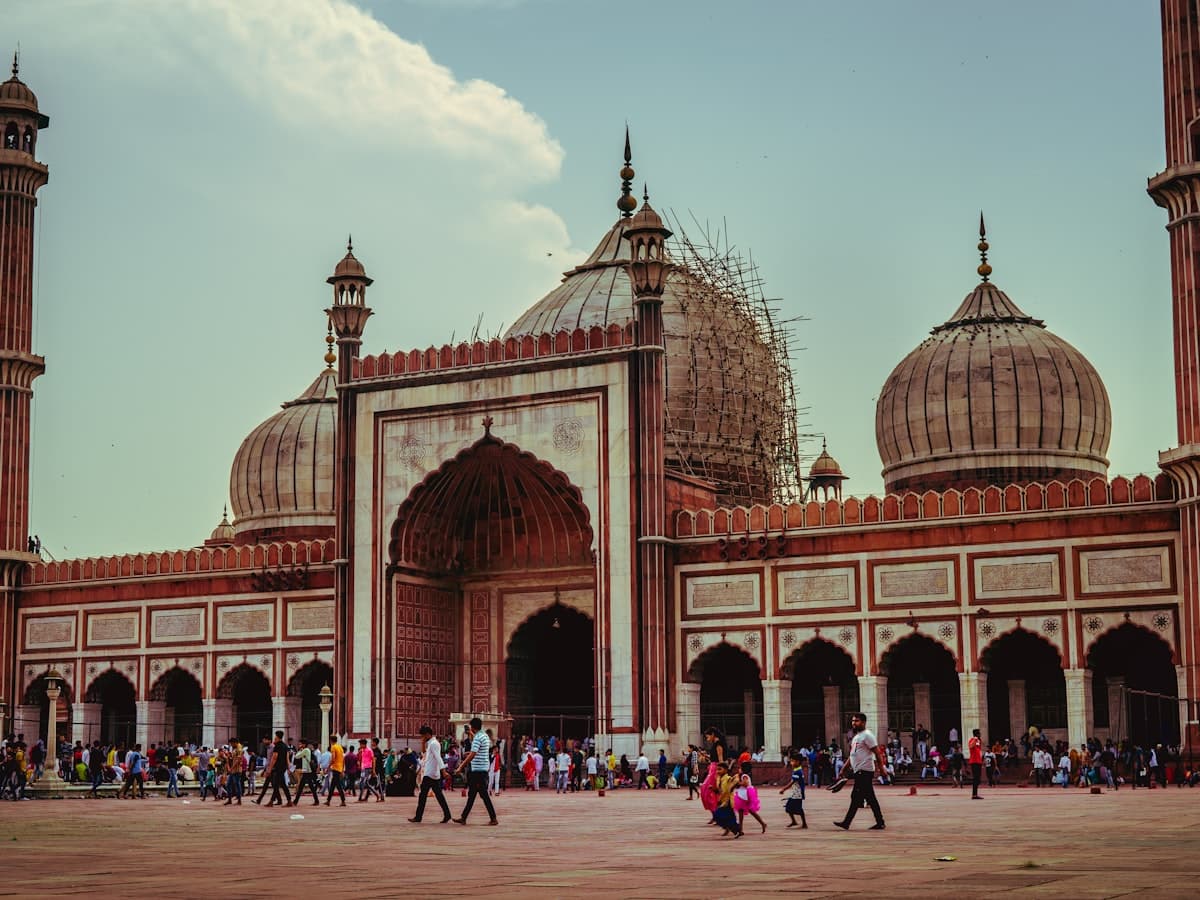
Jama Masjid is one of the largest mosques in India, and it stands in the middle of one of the busiest parts of Delhi. You walk up red sandstone steps from a street of kebab stalls and loudspeakers, pass through a tall gate and come out into a courtyard of astonishing calm.
That contrast is why it is worth a visit. It is also a working mosque, which changes how you plan. There are prayer times when visitors are asked to wait, a dress code you need to follow and a few fees that change often.
Figures were checked in October 2026. Sources disagree on fees and hours, so treat the numbers as ranges and confirm at the gate.
Jama Masjid at a glance
What to know | |
|---|---|
Where | Old Delhi, close to the Red Fort and Chandni Chowk |
Built | About 1650 to 1656, by Shah Jahan |
Materials | Red sandstone and white marble |
What you see | A vast courtyard, three gates, two minarets and a prayer hall with three domes |
Hours | Sources give about 7:00 am to noon and 1:30 to 6:30 pm. Closed to visitors at prayer |
Time to allow | 45 to 90 minutes |
Best hour | Morning, or late afternoon before sunset |
Best season | October to March |
Entry | Free for Indian visitors. Foreign visitors are quoted ₹300 to ₹500 in some sources |
Run by | The mosque's religious authorities |
A short history
Shah Jahan built Jama Masjid after he moved his capital to Delhi and built the Red Fort. It stands on a small rise opposite the fort, and the builders used red sandstone with bands of white marble. Its design was meant to be the largest and most prominent in the city.
It remains an active mosque. Thousands pray here, especially on Fridays and during the festivals of Eid. That is why the rules differ from those at a museum or a monument.

The prayer hall facade and its minarets.
Hours, prayer and fees
Detail | What sources say |
|---|---|
Visiting hours | About 7:00 am to noon and 1:30 to 6:30 pm. The Delhi Tourism page lists tourist hours that differ for Indian and foreign visitors |
Prayer times | Non-worshippers are asked to wait or leave during prayers, especially Friday noon |
Entry | Free for Indian visitors. Foreign visitors are quoted ₹300 to ₹500 in some sources |
Camera | Some sources quote ₹200 to ₹300. The Delhi Tourism page says photography is free |
Minaret | About ₹100 in some sources |
The sources do not give exact prayer times. Check a prayer timetable for the day, or ask at the gate. Friday is the busiest day and the hardest for sightseers.
Small fees and rules at religious sites are decided by the mosque's administration, not by a national body, and they change often. Carry small notes and ask the price before you pay for anything.
Dress code and etiquette
Rule | What it means |
|---|---|
Cover shoulders, chest and legs | Long trousers or skirt, and sleeves |
Cover your head if you are a woman | Bring a scarf or shawl |
Remove shoes | You leave them at the stand and pay a small tip |
Gown or robe | Some visitors report that robes can be hired at the northern gate |
Behave quietly | Keep your voice low and do not photograph people at prayer |
Treat it as a place of worship first. Do not photograph people without their consent, and stay out of the prayer hall during prayers.

The ablution pool from above.
What to see
Stop | What it is | Allow |
|---|---|---|
The steps and east gate | The grand approach from the street | 10 min |
The courtyard | A huge open square around the pool | 20 min |
The prayer hall | The arched facade and domes | 15 min |
The minaret | A narrow stair with a view of Old Delhi | 20 min |
The side gates | Smaller entrances and the lanes beyond | 15 min |
The courtyard
The courtyard is the largest in the city, and it is where most visitors spend their time. It holds tens of thousands of worshippers at festivals. On an ordinary morning it is spacious and easy to walk, and pigeons wheel over the stones.
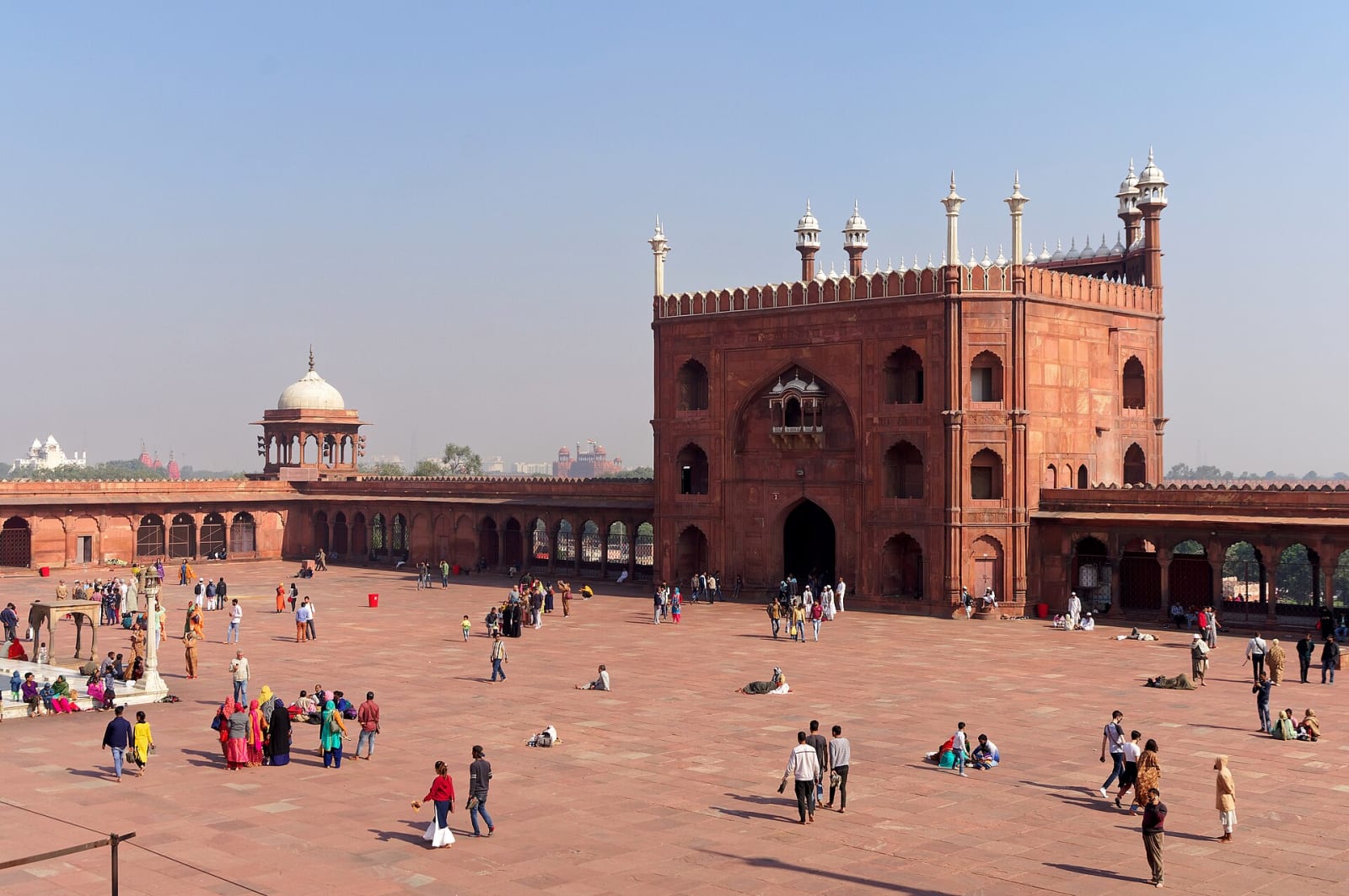
The courtyard and a gate beyond.
The east gate
The great east gate has broad steps leading up to it. This is the main approach, and from the top of the steps you see the Red Fort across the road.

The east gate, with the Red Fort beyond.
The minaret climb
The minaret offers one of the best views over Old Delhi, from the domes of the mosque to the Red Fort and the rooftops of Chandni Chowk. The stair is narrow and steep and the climb is hard work. Visitors report that it is sometimes closed, and that it is not suitable for small children or anyone unsteady. Ask at the gate whether it is open before you pay.
Best time by month
The courtyard stones get hot in the sun, which matters because you walk barefoot. Sunrise and sunset times below are calculated for Old Delhi on the 15th of each month, in Indian Standard Time.
Month | Sunrise | Sunset | Visiting advice |
|---|---|---|---|
January | 7:15 am | 5:46 pm | Cool and hazy. Go mid-morning |
February | 7:00 am | 6:11 pm | Clear and pleasant. Best month |
March | 6:31 am | 6:29 pm | Warm. Go in the morning |
April | 5:56 am | 6:47 pm | Hot. The stones burn by midday |
May | 5:30 am | 7:05 pm | Very hot. Go at opening only |
June | 5:23 am | 7:20 pm | Very hot and dusty |
July | 5:33 am | 7:21 pm | Monsoon. Humid, slippery steps |
August | 5:50 am | 7:01 pm | Monsoon. Showers, fewer visitors |
September | 6:06 am | 6:26 pm | Humid. Clearing |
October | 6:22 am | 5:52 pm | Clear. Festival crowds |
November | 6:43 am | 5:27 pm | Excellent. Air quality can dip |
December | 7:06 am | 5:26 pm | Cool, with morning fog. Go mid-morning |
Old Delhi's air quality varies through the year and is often worst in late autumn and winter. Check the forecast if you are sensitive.
Choosing your time of day
Time | What you get | Best for |
|---|---|---|
Opening | Soft light and few visitors | Photographers and first-timers |
Mid-morning | Warm light and more groups | Short visits |
Midday | Hot stones and glare | Avoid in the hot months |
Late afternoon | Golden light on the domes | The courtyard and the minaret |
Friday noon | Prayers and crowds | Avoid as a sightseer |
Who Jama Masjid suits
Traveller | Why it works | Tip |
|---|---|---|
History readers | A Shah Jahan building in daily use | Hire a guide at the gate |
Photographers | Architecture and street life | Go in the morning |
Food travellers | The lanes around it are famous for kebabs | Pair it with our Old Delhi food walk |
Families | A big open courtyard | Watch for traffic in the lanes |
First-time visitors | A powerful contrast with New Delhi | Go with a guide |
Travellers with limited mobility | Many steps and no ramps at the gates | Ask about the side entrance |
What to pair it with
The Red Fort stands across the road. Read our Red Fort visitor guide.
Old Delhi's lanes are where you eat. Our Old Delhi food walk shows what to try and where to start.
Humayun's Tomb is the calm Mughal counterpoint. See Humayun's Tomb visitor guide.
A two-day plan for the city is in Delhi in two days.
How to plan your visit
Check the prayer time and avoid Friday noon.
Dress properly, with covered legs, shoulders and, for women, a head scarf.
Arrive in the morning, when the stones are cool.
Carry small notes for the shoe stand and any fees.
Ask whether the minaret is open before you pay.
Finish with a food walk through the lanes.
Where it fits in the Golden Triangle
Jama Masjid usually sits on the first or second day of a Golden Triangle trip, with the Red Fort and Old Delhi. Our guide to how many days for the Golden Triangle shows how to place it, and the field guide to places to visit on the Golden Triangle gives the wider picture.
Haveli Dharampura is a restored haveli in the lanes nearby, and The Imperial is a heritage hotel in central Delhi. See how Old Delhi fits a route in the Delhi in depth, 4-day itinerary or the Delhi city break package.
Frequently asked questions
What are the Jama Masjid timings?
About 7:00 am to noon and 1:30 to 6:30 pm, according to several sources. Visitors are asked to wait during prayers, especially Friday noon.
Is there an entry fee for Jama Masjid?
Entry is free for Indian visitors. Some sources quote ₹300 to ₹500 for foreign visitors, and extra fees for cameras and the minaret. Confirm at the gate.
What should I wear to Jama Masjid?
Cover your shoulders, chest and legs, and cover your head if you are a woman. Remove your shoes before you enter the courtyard.
Can you climb the minaret?
Usually, for a small fee, but visitors report that it is sometimes closed. The stair is narrow and steep.
Is Jama Masjid open on Fridays?
It is open, but Friday noon is the main congregational prayer and visitors are asked to stay away. Plan your visit for another day or time.
How long do you need at Jama Masjid?
About 45 to 90 minutes, depending on whether you climb the minaret.
How far is Jama Masjid from the Red Fort?
They face each other across the road, a short walk apart.
Plan your Old Delhi day with us
We time the visit around prayer, the heat and the lanes, and add a guide who knows the neighbourhood. Explore the Golden Triangle destination page or talk to a trip designer.
Photo credits
Prayer hall facade: Pinakpani, CC BY-SA 4.0. Ablution pool: Vyacheslav Argenberg, CC BY 4.0. Courtyard and east gate: Jakub Hałun, CC BY-SA 4.0. All via Wikimedia Commons.
Journeys for this trip
Plan your Golden Triangle trip
Read Next
All Stories →
Golden Triangle Honeymoon Itinerary 7 Days: Delhi, Agra and Jaipur

Golden Triangle Tour Cost Per Person: 2026-27 Budget Guide