
Humayun's Tomb, Delhi: Timings, Tickets and What to Look For
Humayun's Tomb visitor guide: opening hours, ticket prices, the charbagh garden, Isa Khan's tomb, the site museum and how to pair it with Sunder Nursery.
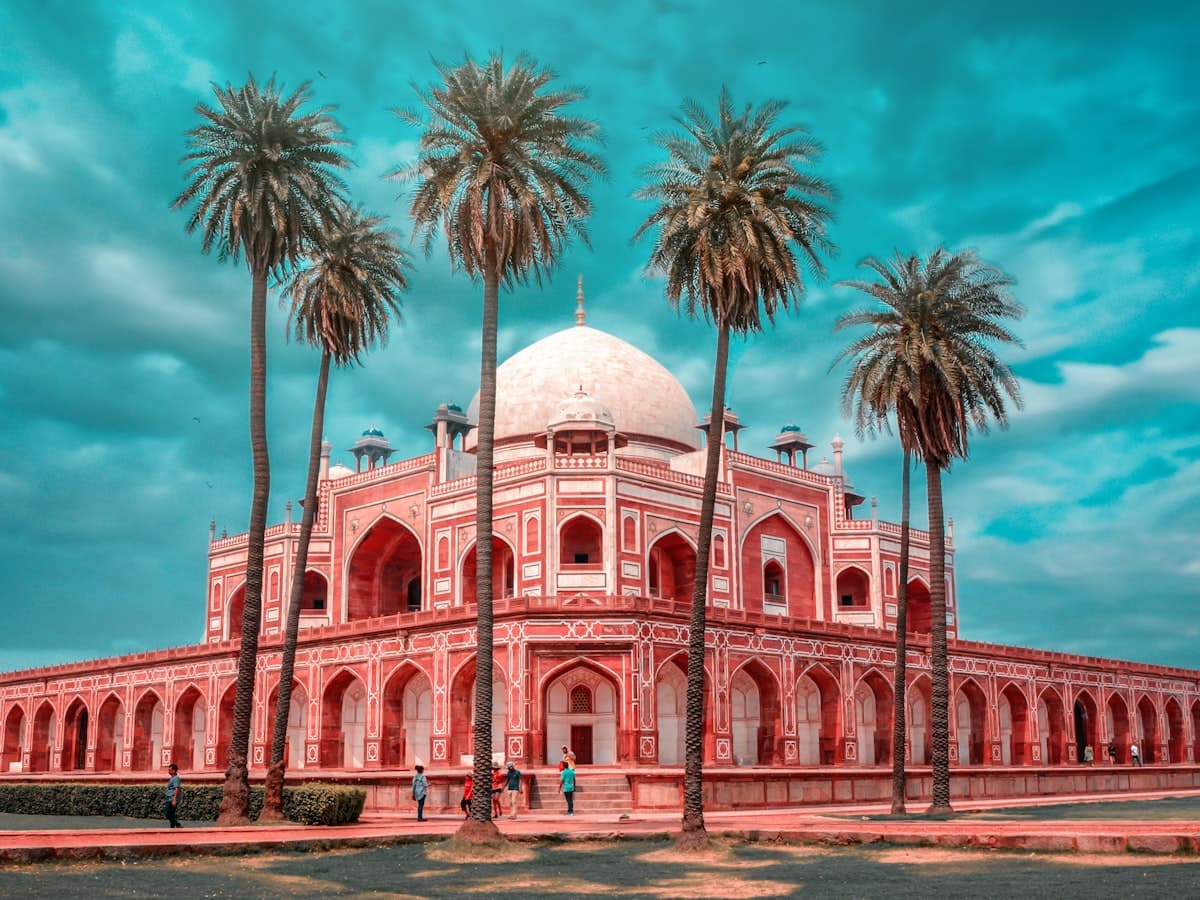
Humayun's Tomb is the building the Taj Mahal grew out of. It stands in the middle of Delhi, in a formal garden, with almost none of the pressure of Agra. Many first-time visitors rank it among their favourite stops on the Golden Triangle.
It also suits the first day of a trip. It is calm, shaded and easy to walk. Jet lag is gentler here than in Old Delhi.
This guide gives you the practical facts, then a walk through the complex, then the places worth pairing with it. Figures were checked in October 2026. Fees and hours are revised from time to time, so confirm at the gate.
Humayun's Tomb at a glance
What to know | |
|---|---|
Where | Nizamuddin East, central Delhi. The nearest Metro station is JLN Stadium |
Hours | Sunrise to sunset, roughly 6:00 am to 6:00 pm. Last entry about 30 minutes before sunset |
Weekly closing day | None. Open daily, including holidays |
Time to allow | 1.5 to 2 hours for the tomb and garden. Add an hour for the site museum |
Best hour | Opening time, or the last two hours before sunset |
Best season | October to March. Winter mornings can be misty |
Commissioned by | Bega Begum, Humayun's senior widow |
Built | Begun in 1565, completed in 1572 |
Heritage status | UNESCO World Heritage Site since 1993 |
Why this tomb matters
Humayun died in 1556. His widow, Bega Begum, commissioned a tomb for him. Work began in 1565 and finished in 1572. She chose Persian architects, Mirak Mirza Ghiyas and his son Sayyid Muhammad.
It was the first building in India to place a domed tomb at the centre of a formal four-part garden, the charbagh. Red sandstone, white marble and a high double dome gave the Mughals a new vocabulary.
About eighty years later, Shah Jahan took the same idea and perfected it at Agra. If you plan to see the Taj Mahal, see this first. The Taj will make more sense afterwards. Our guide to timing your Taj Mahal visit covers that side of the story.

The tomb's double dome and arched facade. White marble picks out the red sandstone.
Opening hours and tickets
Item | Detail |
|---|---|
Daily hours | Sunrise to sunset, about 6:00 am to 6:00 pm |
Closing day | None |
Foreign visitors | About ₹550 to ₹600 |
Indian citizens and SAARC or BIMSTEC visitors | About ₹35 to ₹50 |
Children under 15 | Free |
Still photography | Free |
Video filming | About ₹25 |
The Archaeological Survey of India (ASI) manages the monument. Online tickets cost slightly less than cash tickets, and sources differ by a few rupees because rates are revised. Confirm the current price on the ASI booking page or at the counter.
The site museum (see below) has its own access arrangements. Ask at the entrance when you arrive.
A walk through the complex
The complex is larger than the tomb. Allow time to walk the whole enclosure rather than photographing the main facade and leaving.
Stop | What it is | Allow |
|---|---|---|
Entrance and the site museum | A modern museum at the entrance, opened in July 2024 | 45 to 60 min |
Isa Khan's tomb | An older garden tomb inside the complex, known for its rich decoration | 15 min |
The charbagh | Four garden squares divided by raised paths and water channels | 20 min |
The main mausoleum | The tomb itself, with its double dome and arched terrace | 30 min |
The terrace and upper views | The platform around the tomb, with views across the garden | 15 min |
The charbagh
The garden is the first thing to read. Two main axes cross at the tomb, dividing the ground into four squares. Water channels run along the paths.
Stand at the end of the main water channel and look towards the tomb. This is the framing the Mughals intended.

The charbagh water channel, with the tomb at the end of the axis.
The mausoleum
The tomb sits on a high platform lined with arched cells. Red sandstone is inlaid with white marble. The double dome rises above small domed pavilions called chhatris, an Indian feature set against a Persian-style dome.
Inside are the cenotaph and several other graves of the Mughal family. The space is cool and quiet. Walk the terrace afterwards. The arches look different from each side.

The arcaded base gives the tomb its scale. Visitors in the frame make it clear.
Isa Khan's tomb
Isa Khan's tomb stands in its own walled garden inside the complex. It was built before Humayun's tomb, and it is notable for its profuse ornamentation. It is also a good test of how much you enjoy detail. Many visitors walk past it. We would stop.
The site museum
A modern site museum opened at the complex in July 2024. It was designed as a low, underground building so that it does not compete with the monuments around it. It holds more than 500 objects from the National Museum, the ASI and the Aga Khan Trust for Culture, with live craft demonstrations.
It is worth the hour if you enjoy context. If your day is short, spend the time in the garden instead.
The restoration that saved it
By the 2000s the tomb was in poor condition. From 2007 to 2013, the Aga Khan Trust for Culture worked with the ASI on a major conservation project. Craftspeople used traditional materials and methods, including lime plaster, and the work took around 200,000 work days.
The restored complex was inaugurated in September 2013. Nearby monuments were restored at the same time. The result is why the stone and the garden look so clean today.
Who Humayun's Tomb suits
Traveller | Why it works | Tip |
|---|---|---|
First-time visitors | The best introduction to Mughal architecture, and calm | Visit before the Taj if you can |
Jet-lagged arrivals | Flat, shaded and quiet | Go in the morning of your first full day |
Photographers | Symmetry, low sun on red stone, long water axes | Arrive at opening or in the last hour before sunset |
History readers | Persian design transplanted into India | Ask your guide about Bega Begum's role |
Families | Open lawns and room to move | Bring water and let children run the paths |
Travellers with limited mobility | Mostly flat, but there are steps to the platform | Ask about the accessible entrance |
What to pair it with
Humayun's Tomb sits in a cluster of good places. A well-planned morning can cover several.
Sunder Nursery is a restored heritage park next door, with more Mughal-era tombs set among trees. It reopened to the public in February 2018. It makes a gentle walk after the tomb.
The Nizamuddin area is home to the shrine of the Sufi saint Hazrat Nizamuddin Auliya. It is a living neighbourhood, and a guided walk helps. Dress modestly.
Lodhi Garden holds fifteenth-century tombs and is Delhi's favourite place for a morning walk. Our guide to two days in Delhi puts it into a sensible route.
Old Delhi is the opposite experience: crowded, loud and delicious. Our guide to Old Delhi through its food shows how to approach it.
How to plan your visit
Arrive at opening, or two hours before sunset. The light is best and the crowds are smallest.
Walk the whole enclosure. Isa Khan's tomb and the garden edges are part of the story.
Wear comfortable shoes. The paths are long and partly gravel.
Hire a licensed guide at the gate, or book through us. Agree the route and price first.
Pace the day. Combine it with Sunder Nursery and lunch, not with five more monuments.
Where it fits on the Golden Triangle
Humayun's Tomb works best on your first or second day in Delhi, before the long drive to Agra. It sets up the Taj. If you are still deciding how many days to give the route, our guide to how many days you need for the Golden Triangle will help.
For the wider picture of Delhi, Agra and Jaipur, read our Golden Triangle highlights guide. If you like a slow start, a stay at The Lodhi or The Imperial puts you close to the best of the city.
See how it fits into a route in Golden Triangle Classic, 5 days or the First-Timer's Golden Triangle package.
Frequently asked questions
What are the opening hours of Humayun's Tomb?
It opens at sunrise and closes at sunset, roughly 6:00 am to 6:00 pm, every day of the week. The last entry is about 30 minutes before closing.
How much does Humayun's Tomb cost?
Foreign visitors pay about ₹550 to ₹600. Indian citizens pay about ₹35 to ₹50, with a small saving for online tickets. Children under 15 enter free. Confirm the current rate at the counter, since prices are revised.
How long do I need at Humayun's Tomb?
Allow one and a half to two hours for the tomb, garden and Isa Khan's tomb. Add an hour for the site museum and more if you plan to continue to Sunder Nursery.
Is Humayun's Tomb better than the Taj Mahal?
They are different experiences. Humayun's Tomb is calmer and shows where the ideas began. The Taj is the finished version. Seeing both, in that order, is the best way.
Why is it called the first garden tomb in India?
It was the first major Mughal tomb set at the centre of a formal charbagh garden. The Taj Mahal later developed the same layout.
Is the site museum worth visiting?
Yes, if you enjoy context and craft. It opened in July 2024, holds more than 500 objects, and is designed as an underground building so that it leaves the skyline untouched.
Is Humayun's Tomb suitable for older travellers?
Yes. The garden is flat and shaded in places. There are steps to the tomb platform, so ask about the accessible route in advance.
Plan your Delhi visit with us
We build Delhi days around the right hour and the right guide, with a car waiting. Explore the Delhi destination page or talk to a trip designer.
Read Next
All Stories →
Red Fort, Delhi: Timings, Tickets and a Walk Through the Lal Qila

Golden Triangle Highlights: Delhi, Agra and Jaipur, Place by Place