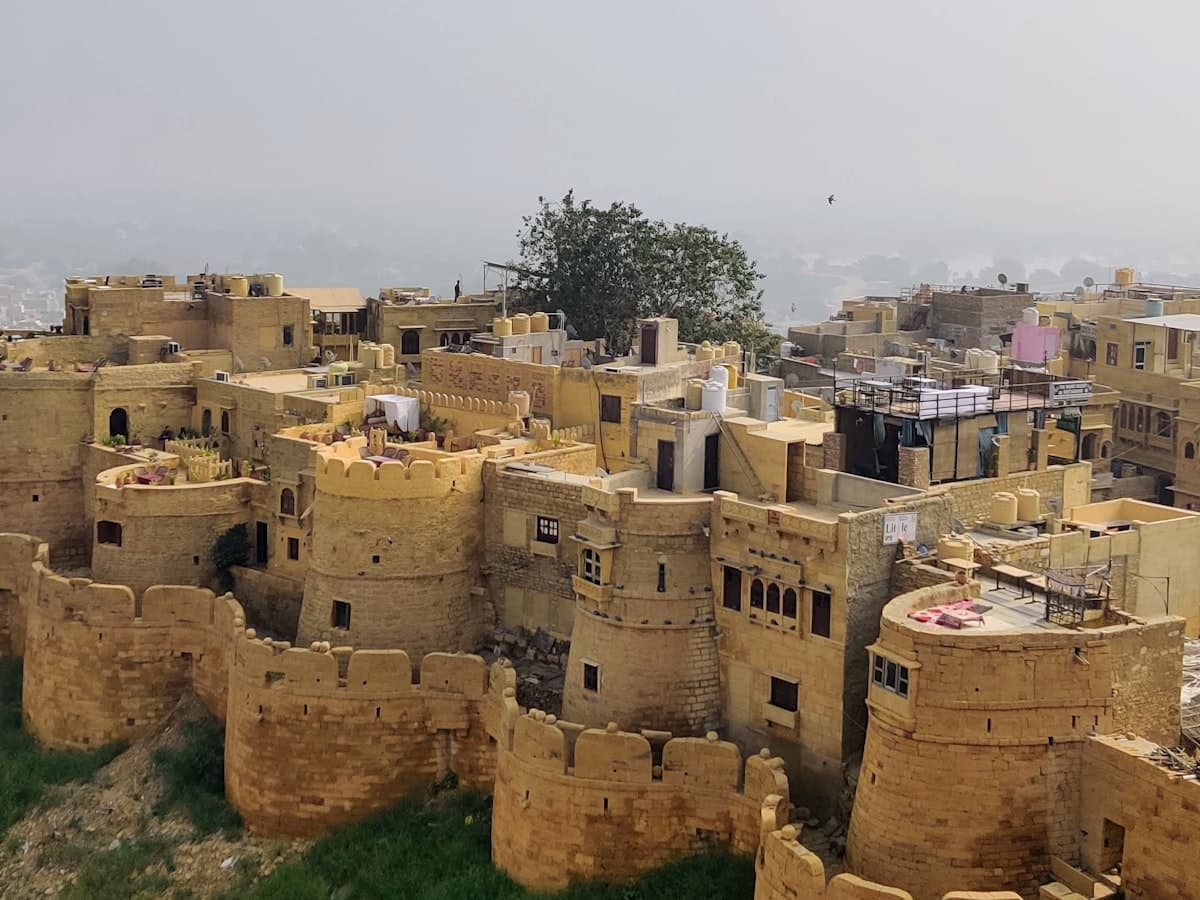
Amber Fort, Jaipur: Timings, Tickets and How to See It Properly
Amber Fort guide: opening hours, ticket prices, the Sheesh Mahal, the light and sound show, a courtyard-by-courtyard route and why to skip the elephant ride.
Amber Fort is the first thing most people picture when they think of Rajasthan. A sandstone palace climbs a ridge above a still lake, and four courtyards open one into the next. It is easy to reach. It is also easy to see badly.
Arrive at the wrong hour and you share it with a tour-bus crowd. Walk it in the wrong order and the best rooms pass in a blur. This guide gives you the practical facts first, then a courtyard-by-courtyard route, then the things worth doing nearby.
Every figure below was checked in October 2026. Prices and timings change, so treat the tables as a planning guide and confirm at the gate.
Amber Fort at a glance
What to know | |
|---|---|
Where | About 11 km north of central Jaipur, roughly 30 minutes by road |
Daytime hours | 8:00 am to 5:30 pm, with the last entry around 5:00 pm |
Weekly closing day | None. Open every day |
Time to allow | 2 to 3 hours for all four courtyards |
Best hour | Opening time, 8:00 am. Tour buses typically arrive around 9:30 am |
Best season | October to March. April to June often passes 40°C |
Photography | Allowed in the fort. Not allowed inside the Shila Devi shrine |
Built | Begun in 1592 by Raja Man Singh I, completed in 1599, expanded by Jai Singh I |
Heritage status | UNESCO World Heritage Site since 2013, as part of the Hill Forts of Rajasthan |
A short history, so the rooms make sense
Raja Man Singh I began the fort in 1592. It took about seven years to complete the first phase. Later rulers kept adding to it for roughly 150 years, and Jai Singh I expanded it in the 1600s.
Amber stayed the Kachwaha capital until 1727. In that year Sawai Jai Singh II moved the court to a new planned city on the plain, Jaipur. Amber was left as a hill palace, which is partly why it survives so well.
Maota Lake, below the fort, was the palace's water source. The garden floating in it, Kesar Kyari, is one of the best views in the whole complex. You see it from the road, not from inside.

Amber Fort across Maota Lake. The best reflection is early, before the breeze lifts.
Opening hours and the evening show
Experience | Timing | Notes |
|---|---|---|
Daytime visit | 8:00 am to 5:30 pm | Last entry around 5:00 pm. No weekly closure |
Light and sound show | Around 6:30 pm in winter, 7:00 pm in summer | Runs about an hour. Offered in Hindi and English. Separate ticket |
Shila Devi Temple | Inside the first courtyard | Shoes off. No photography. Queues move fast |
The evening show is a story told in light across the fort walls. It suits families and anyone who wants Amber without the heat. It does not replace the daytime visit, because you cannot enter the palace rooms at night.
Ticket prices
Foreign and Indian visitors pay different rates. Student concessions exist but the figures vary by source, so ask at the counter.
Ticket | Indian visitors | Foreign visitors |
|---|---|---|
General daytime entry | ₹100 | ₹500 |
Composite ticket (about two days) | ₹300 to ₹400, depending on the year | ₹1,000 |
Light and sound show | About ₹200 to ₹250 | About ₹200 to ₹250 |
The composite ticket covers several Jaipur sites, including Jantar Mantar, Hawa Mahal, Albert Hall and Nahargarh. It pays for itself if you plan to see three or more of them. Children under about seven enter free.
Getting there and getting up the hill
Cars park at the base of the fort. From there it is roughly a ten-minute walk up a cobbled ramp to the main gate, Suraj Pol. A jeep service runs up the same ramp for those who cannot manage the climb.
A private car with a driver who waits is the easiest option. It also lets you start at 8:00 am without thinking about transport.
A note on elephants
You will see elephants carrying visitors up the ramp. We recommend against it. The rides have drawn long-running criticism over animal welfare, and jeeps or the walk are the better choice. We do not book elephant rides.
The route through the fort
The fort is laid out as a sequence. Follow it in order and the palace reveals itself the way it was designed to. Allow two to three hours.
Stop | What it is | Allow |
|---|---|---|
Suraj Pol (Sun Gate) | The main entrance at the top of the ramp | 5 min |
Jaleb Chowk | The first courtyard, where soldiers once assembled | 15 min |
Shila Devi Temple | A shrine with a black stone idol behind silver doors | 10 min |
Diwan-i-Aam | The public audience hall, with 27 colonnades | 15 min |
Ganesh Pol | The painted gateway into the private palaces | 10 min |
Sheesh Mahal (Jai Mandir) | The mirrored palace | 30 min |
Sukh Niwas | A cooling hall fed by a water channel | 10 min |
Charbagh garden | The formal garden between the two palaces | 10 min |
Zenana | The queens' courtyard | 20 min |
Jaleb Chowk and the Shila Devi Temple
Jaleb Chowk is the big open courtyard you enter first. The women of the court watched events here from screened balconies above.
Just off it is the Shila Devi Temple. The black stone idol sits behind a double door covered in silver. Tradition says Raja Man Singh received the deity after a campaign in Bengal in 1604. Remove your shoes and do not photograph the shrine.
Diwan-i-Aam
The public audience hall stands on 27 colonnades and mixes Rajput and Mughal styles. The sandstone pillars are carved and the roofline is open to the air.

Carved pillars and a worn wooden door. The detail is in the corridors, not only the big rooms.
Ganesh Pol and the private palaces
Ganesh Pol is the painted gateway into the private palaces. Pause here. Through it you enter the part of the fort the court actually lived in.
Sheesh Mahal
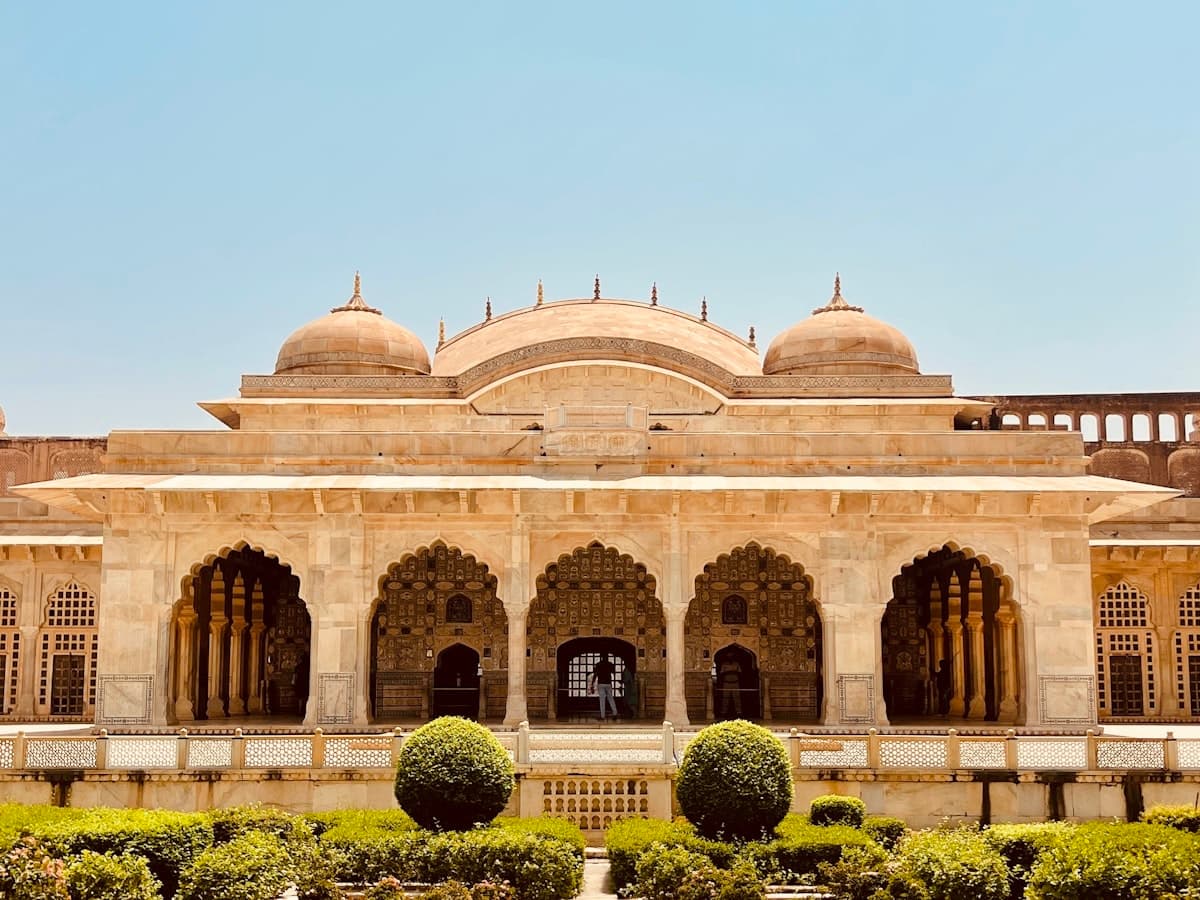
The Sheesh Mahal is the room people remember. Thousands of mirror pieces cover the walls and ceiling. The mirrors were set to answer candlelight, so the effect is far more subtle in daylight.
Go early. The room is small, and it fills quickly once the groups arrive. A guide can show you how the mirrors were meant to work. Agree any price before the demonstration, not after.
The marble facade facing the garden is the most photographed part of the fort.
Sukh Niwas and the garden
Opposite the Sheesh Mahal is Sukh Niwas, the Hall of Pleasure. Water ran through marble channels to cool the room. It is an early example of air-conditioning by design.
The formal charbagh garden between the two palaces gives a quiet pause before the last courtyard.
Zenana
The Zenana was the queens' courtyard. Raja Man Singh's apartments are arranged around it, with a shared upper corridor. It is calmer than the public courtyards, and a good place to end.
The ramp, the paths and the view
Amber sits on a ridge above the lake, and the approach paths zigzag up the slope. From the lakeside road or from the upper terraces you see the whole shape of the fort.
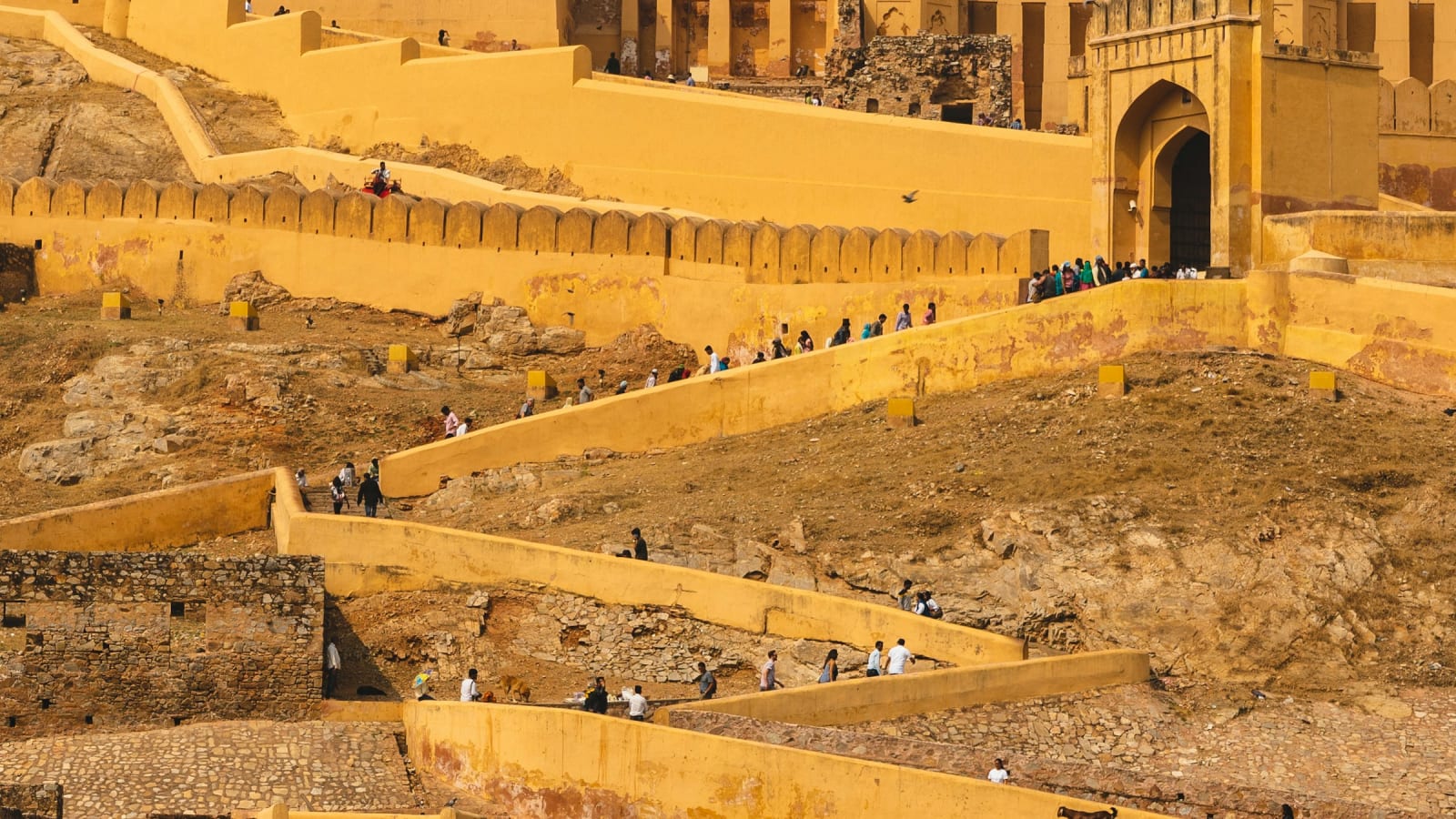
The zigzag approach. It is worth walking at least one stretch of it.
Who Amber suits
Traveller | Why it works | Tip |
|---|---|---|
First-time visitors | The clearest introduction to Rajput palace architecture | Go at 8:00 am and hire a licensed guide |
Photographers | Gold morning light on east-facing stone, lake reflections | Shoot the lake before the crowds, the Sheesh Mahal early |
Families with children | Open courtyards, lots to climb and explore | Use a jeep up the ramp for small children |
Couples | The evening light and sound show, and sunset from the ridge | Pair Amber with Nahargarh at sunset |
History readers | Layers from the 1590s to the 1700s | Ask your guide about the move to Jaipur in 1727 |
Travellers with limited mobility | A lot of walking on uneven stone | Request the jeep and a shorter route |
What to see nearby
Amber pairs well with a few quiet stops close by. Together they make a half-day.
Panna Meena ka Kund is a symmetrical stepwell a few minutes' walk from the fort, free to enter and good for photographs.
Jaigarh Fort is the military fort on the ridge above. A subterranean passage once connected it to Amber as a wartime escape route. It is home to the large Jaivana cannon.
Anokhi Museum of Hand Printing is in a restored haveli in Amer village. It shows how block printing works and is usually quiet. Our guide to Rajasthan's craft and textile trail explains what to look for before you buy.
Jal Mahal, the water palace in Man Sagar Lake, is a photo stop only. You cannot go inside.
Nahargarh Fort is a ridge fort with sunset views over Jaipur.
How to plan your visit
Arrive at 8:00 am. This single choice changes the visit more than any ticket or guide.
Wear proper shoes and carry water. The stone is uneven, and you will walk two to three kilometres without noticing.
Hire a licensed guide at the gate, or book through us. Agree the route and price first. Politely decline any detour to a shop.
Do the courtyards in order. The sequence is the point.
Eat after, not during. There is a cafe inside, but you will eat better in Jaipur.
Save the evening for the show or for Nahargarh. Do not try to fit both.
Where Amber fits in a Jaipur stay
Amber takes a morning. Pair it with Jaipur's City Palace and Jantar Mantar in the afternoon, or with Nahargarh at sunset. Hawa Mahal is a quick stop at sunrise. For a full plan of the rest of the city, and the wider state, read our guide to the best places to visit in Rajasthan.
If Jaipur is one stop in a longer trip, see how to order your first Rajasthan journey. To sleep in a palace after a morning at the fort, our guide to Rajasthan's heritage hotels helps you choose. Rambagh Palace and Alsisar Haveli are both in Jaipur.
For a built route, look at Rajasthan Golden Cities in four days or the Rajasthan Royal Heritage package.
Frequently asked questions
What are Amber Fort's opening hours?
Daytime hours are 8:00 am to 5:30 pm, with the last entry around 5:00 pm. The fort is open every day of the week.
How much is the Amber Fort ticket?
General entry is ₹100 for Indian visitors and ₹500 for foreign visitors. A composite ticket costs ₹1,000 for foreign visitors and covers several Jaipur sites for about two days. Always confirm at the counter, as prices are revised.
How long does Amber Fort take?
Allow two to three hours. A quick highlights walk takes about 40 minutes, but it skips most of what makes the fort worth the trip.
What is the best time to visit Amber Fort?
Arrive at 8:00 am. The light is gold, the crowds are small and the Sheesh Mahal is calm. October to March is the comfortable season.
Is the light and sound show worth it?
It is a good evening activity for families and first-time visitors. It does not let you into the palace rooms, so treat it as an addition to a daytime visit, not a substitute.
Is the Sheesh Mahal best at a particular time?
Early in the day, when the room is quiet. The mirrors were designed for candlelight, so the effect is subtle in daylight.
Should I ride an elephant up to the fort?
No. We recommend walking or taking a jeep. Elephant rides have been widely criticised on animal-welfare grounds.
Is Amber Fort suitable for older travellers?
Yes, with planning. The ramp is steep and the stone is uneven, so a jeep ride up and a slower, shorter route help a great deal.
Plan your visit with us
A trip designer can fit Amber into your Rajasthan route at the right hour, with a guide and a car already waiting. Browse the Rajasthan destination page or talk to a trip designer.
Read Next
All Stories →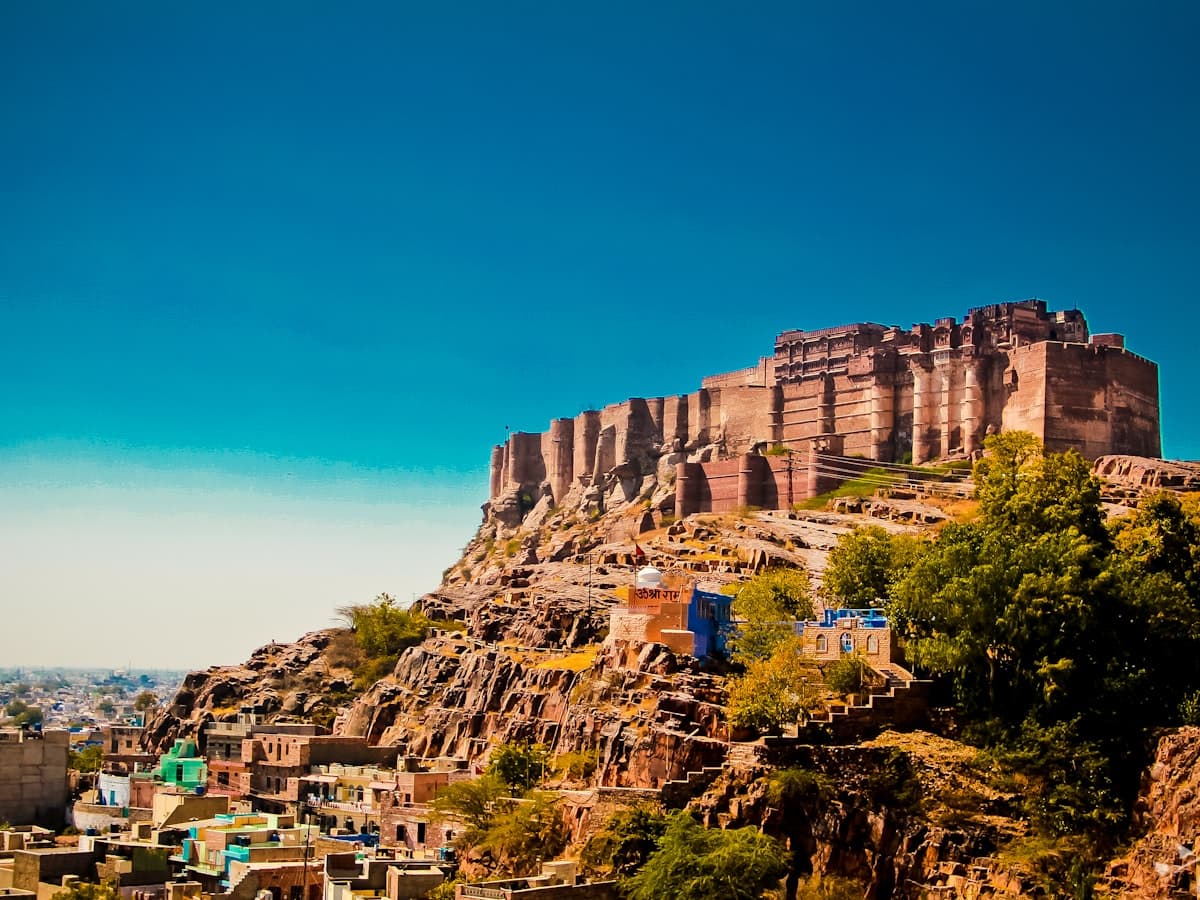
Places to Visit in Rajasthan: Forts, Palaces, Lakes and Markets, and Who Each Suits
Pushkar: A Traveller's Guide to Rajasthan's Sacred Lake Town