Nahargarh Fort at Sunset: The Best View Over Jaipur
Nahargarh Fort guide: opening hours, entry fee ranges, when to arrive for sunset by month, what to see inside and how to reach it from Jaipur.
Most of Jaipur's forts make you look up. Nahargarh lets you look down.
It sits on the rim of the Aravalli ridge above the Pink City, and what visitors come for is not so much the fort as the view. The old city lies spread below in a grid. Jal Mahal floats in its lake to one side. As the light drops, the whole thing turns amber and then the lamps come on.

Jaipur at sunset from the Nahargarh ridge.
This guide gives you the practical answers first: hours, fees, how to get there and when to arrive. Then it covers what to see and how to build the evening around it.
At a glance | |
|---|---|
Where | On the Aravalli ridge above the old city of Jaipur |
Built | 1734, by Maharaja Sawai Jai Singh II |
Hours | About 10 am to 5:30 pm; evening hours in winter are reported but unconfirmed |
Entry | Sources range from ₹50 to ₹100 (Indian) and ₹200 to ₹600 (foreign) |
Time to allow | 1.5 hours inside, plus the drive |
Best time | The hour before sunset, October to March |
What Nahargarh is
Nahargarh was built in 1734 by Maharaja Sawai Jai Singh II, the founder of Jaipur, as part of the ring of defences along the ridge. Its older name was Sudarshangarh. It was never really besieged. Its job was to watch over the new city and to link the forts on the hill, Amber and Jaigarh among them.
The name means "abode of tigers", and a local story explains it. A spirit, the tale goes, disturbed the builders until a shrine was raised in its honour. That is folklore, not documented history, but it is the story every guide tells.
The fort you walk through today is more a palace than a stronghold. The best-preserved part is Madhavendra Bhawan, a summer retreat added in the late nineteenth century by Sawai Madho Singh. Sources date the work differently, but they agree on the builder and the purpose.
Timings and tickets, and why you should check
Nahargarh is one of the sites where sources disagree most, so read the numbers below as ranges.
Hours. Most sources give daytime hours of about 10 am to 5:30 pm. Some add that the fort stays open into the evening, up to about 9 pm, in the peak winter season. Others say entry closes at 5 pm but you may stay inside after that. We could not confirm the evening hours from an official page, so ask your hotel or driver on the day.
Entry fee. Sources quote ₹50 to ₹100 for Indian adults and ₹200 to ₹600 for foreign visitors. Student rates are much lower. A composite ticket that covers several Jaipur monuments is sold at some sites. The state tourism department and the Department of Archaeology and Museums set these, and they change, so confirm at the gate.
Extras. Still and video cameras can attract a small separate fee. The Jaipur Wax Museum inside the complex has its own, much higher ticket.
The practical rule. Carry cash, arrive at least an hour before sunset, and treat the printed hours as a guide.
Getting there
The fort is roughly 15 km by road from the old city, a drive of 25 to 40 minutes depending on traffic. A taxi or a hired car with a driver is the sensible choice. There is no regular public transport to the top, and an auto-rickshaw can be hard to find for the return.
The road climbs through hairpin bends, so a driver who knows it helps. Many travellers combine it with Amber Fort and Jaigarh on the same ridge, then end at Nahargarh for sunset. That order works because Amber is best early, when the light is soft and the crowds are thin.
What to see inside
You do not need long. An hour and a half is plenty for the fort itself, and the rest of the time is for the view.
Madhavendra Bhawan. The central palace, with a series of near-identical apartments around a courtyard, painted corridors and lattice windows. Its layout was designed so that the king could reach each queen's quarters without crossing the others, a detail guides like to point out. Walk it slowly, because the upper terraces give the best framed views.
The ramparts. A long walkway runs the length of the wall, and this is where the city view opens. Walk to the far end if you can. The crowd thins quickly past the first bastion.
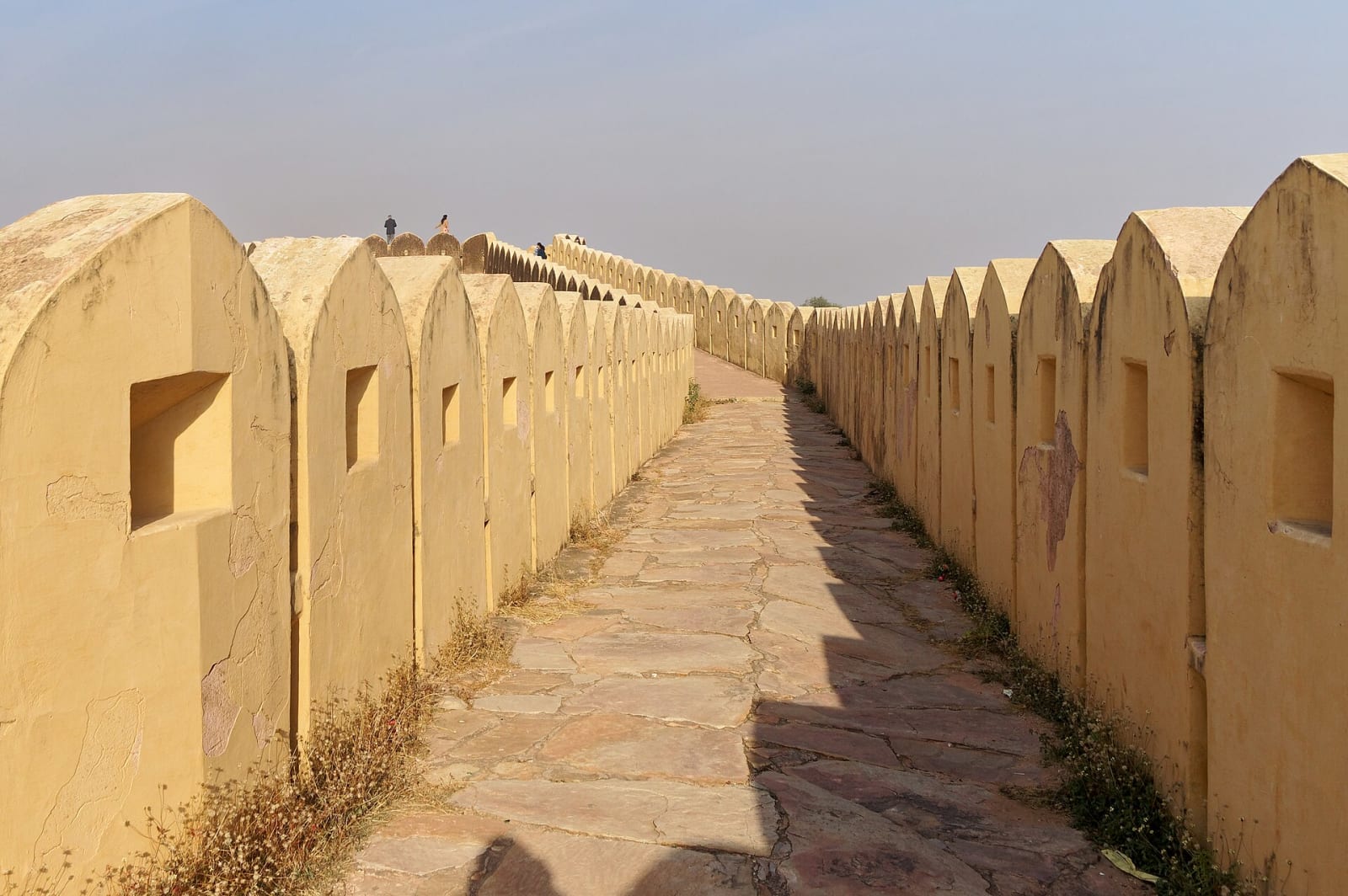
The rampart walk.
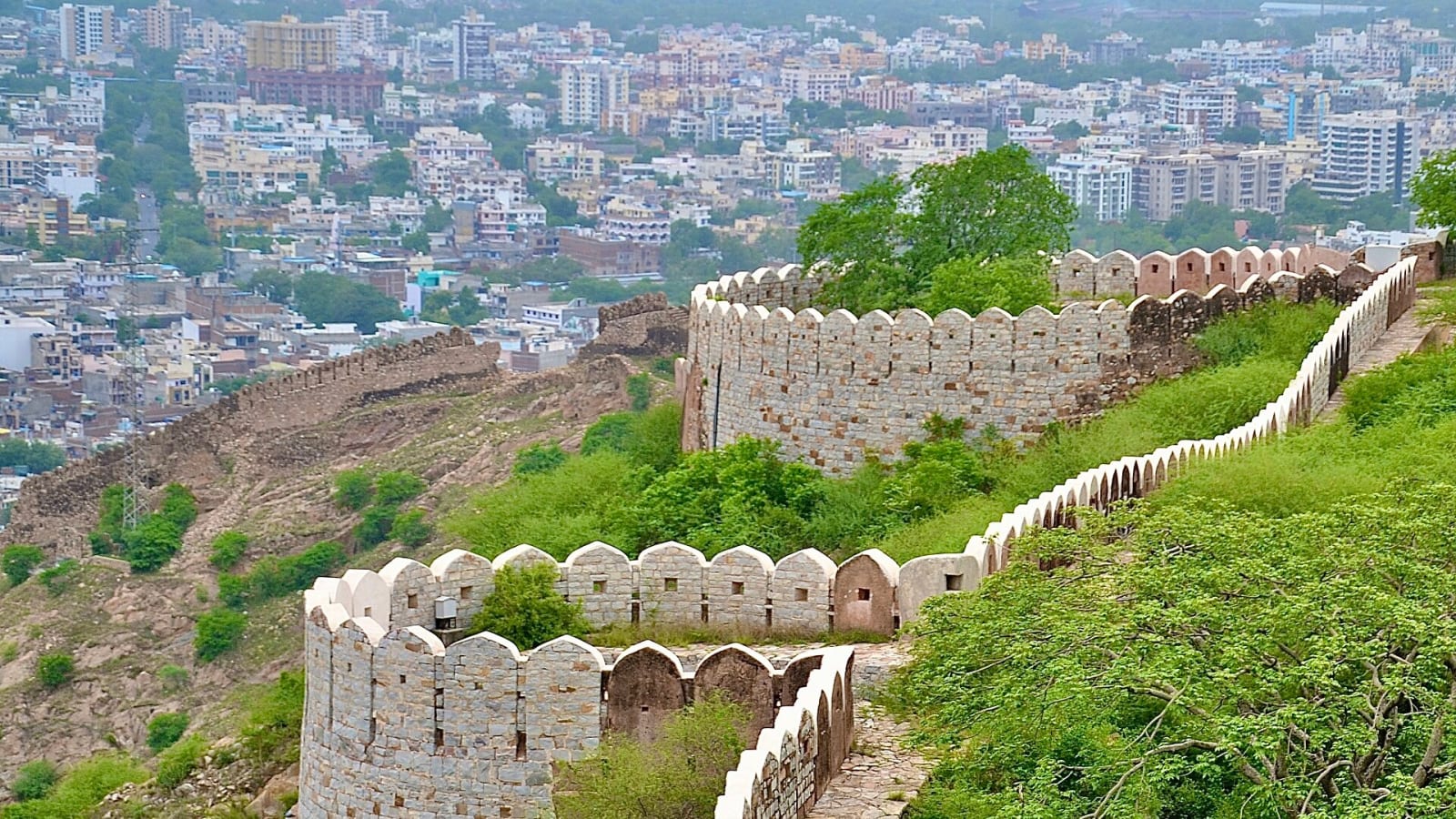
The fort wall above the city.

Rooftops and domed pavilions of the palace.
The rooftop café. A restaurant run by the state tourism corporation sits at the top of the complex and serves tea, cold drinks and snacks. Sunset with a cup of chai is the point, not the menu.
The Wax Museum. A private attraction near the entrance. It is a matter of taste, and guides tend to advise skipping it unless you have time to spare.
The Biological Park. Nahargarh Biological Park is a separate zoo-style reserve on the same hill, with its own ticket and its own hours. It is reported closed on Tuesdays. It is a different kind of outing, so do not squeeze it in before sunset.
When to arrive for sunset
Jaipur's sunset moves a long way through the year. Based on a solar-position calculation for the city, it falls at about 5:35 pm in December, 6:35 pm in March and 7:20 pm in June.
Month | Sunset in Jaipur | Aim to arrive by |
|---|---|---|
October | 6:00 pm | 4:45 pm |
November | 5:35 pm | 4:20 pm |
December | 5:35 pm | 4:20 pm |
January | 5:55 pm | 4:40 pm |
February | 6:20 pm | 5:00 pm |
March | 6:35 pm | 5:20 pm |
April | 6:50 pm | 5:35 pm |
May | 7:05 pm | 5:50 pm |
June | 7:20 pm | 6:00 pm |
July | 7:25 pm | 6:10 pm |
August | 7:05 pm | 5:50 pm |
September | 6:30 pm | 5:15 pm |
These are calculated for the 15th of each month in IST. They shift by a few minutes within the month.
The best light is in the hour before. In the cooler months that means arriving by about 4:30 pm, so you have time to walk the rampart before the crowd gathers. In summer, sunset comes so late that the fort is hot until almost the last minute, so go late and bring water.
After sunset the city lights come on, and for many people that is the better moment. If the fort is open into the evening in your month, stay for it. If not, the drive down at dusk is still pretty.
Which month to go
October to March is the comfortable season. Mornings are cool and evenings are clear. This is also when the fort is busiest at sunset.
April to June is hot. Sunset is late and the stone holds heat until well after dark. Go in the last hour.
July to September is the monsoon. The hills turn green and the views are lovely when the sky clears, but it can be wet and misty. The road is slippery after heavy rain.
Winter evenings are chilly on the ridge. A light jacket from November to February is worth carrying.
Nahargarh or Jaigarh?
The two forts sit on the same ridge and are often visited together. They offer different things.
Nahargarh is about the view and the evening. It is the one to choose if you have time for only one hill fort at sunset. Jaigarh is a working fortress, a place of cannon foundries, armouries and a very large cannon on wheels, and it is better seen in daylight. If you have a full day, do Amber in the morning, Jaigarh at midday and Nahargarh at the end.
Who it suits
Nahargarh is good for almost everyone. Photographers and couples get the most out of it. Families can manage it easily, though young children need watching near the low walls. Anyone with limited mobility should know there are uneven stones and steps, and that the car park is some way from the best viewpoint. Visitors who prefer to see only the headline sights can skip the interior and simply go for the view.
How to plan the evening
Start at Amber in the morning. Read our Amber Fort guide for the timing.
Spend the middle of the day in the city. The Hawa Mahal guide and the City Palace are close together.
Leave for Nahargarh about two hours before sunset. That gives you the drive, the ticket queue and time on the rampart.
Walk the rampart first, then the palace. The crowds arrive at the viewpoint last.
Stay for the lights if the fort is open. Otherwise drive down just after sunset.
Eat in the city afterwards. The old town has good late dinners.
Where it fits in a Rajasthan trip
Jaipur is usually the first city on a Rajasthan route, and Nahargarh makes a fine first-evening stop after the flight or train. Our guide to the order of Jaipur, Jodhpur and Udaipur shows how the cities fit together, and the Rajasthan destination page gives the wider picture.
For somewhere to stay, Rambagh Palace and Alsisar Haveli both make good bases. Our Rajasthan Royal Heritage journey includes the city and its forts in a single planned route.
Frequently asked questions
What are the Nahargarh Fort timings?
Most sources give about 10 am to 5:30 pm daily, with some reporting later hours in the winter season. Confirm on the day, because sources disagree.
What is the entry fee for Nahargarh Fort?
Sources quote about ₹50 to ₹100 for Indian adults and ₹200 to ₹600 for foreign visitors. Cameras may cost extra. Check at the gate.
What is the best time to visit Nahargarh for sunset?
Arrive about an hour before sunset. In winter that means roughly 4:30 pm, and in summer around 6:00 pm.
How far is Nahargarh Fort from Jaipur?
About 15 km by road from the old city, a drive of 25 to 40 minutes depending on traffic. A taxi or private car is the easiest way.
Is Nahargarh Fort open at night?
Some sources report evening hours up to about 9 pm in the peak season. This is not confirmed from an official page, so ask your hotel before planning around it.
Is Nahargarh worth visiting?
For the view, yes. It is one of the best places to see Jaipur from above, and it takes little time. Do not expect the scale of Amber.
Can I visit Nahargarh and Jaigarh on the same day?
Yes. They are on the same ridge. Go to Jaigarh earlier and keep Nahargarh for sunset.
Plan your Jaipur days with us
We build the order of the forts, the drivers and the right evening for your dates. Explore the Rajasthan destination page or talk to a trip designer.
Photo credits
Sunset over Jaipur: Tanmay Singh, CC BY-SA 4.0. Fort wall above the city: Harshil s mehta, CC BY 4.0. Rampart walk and palace rooftops: Jakub Hałun, CC BY-SA 4.0. All via Wikimedia Commons.
Journeys for this trip
Plan your Rajasthan trip
Read Next
All Stories →
Udaipur with Kids: A Family Guide to the City of Lakes
Udaipur to Jodhpur: Distance, Time by Road and Train