Qutub Minar, Delhi: Timings, Tickets and a Walk Through the Complex
Qutub Minar guide: timings, ticket prices, why you cannot climb it, the Iron Pillar, Alai Darwaza, best month and hour, and how to pair it with Mehrauli.
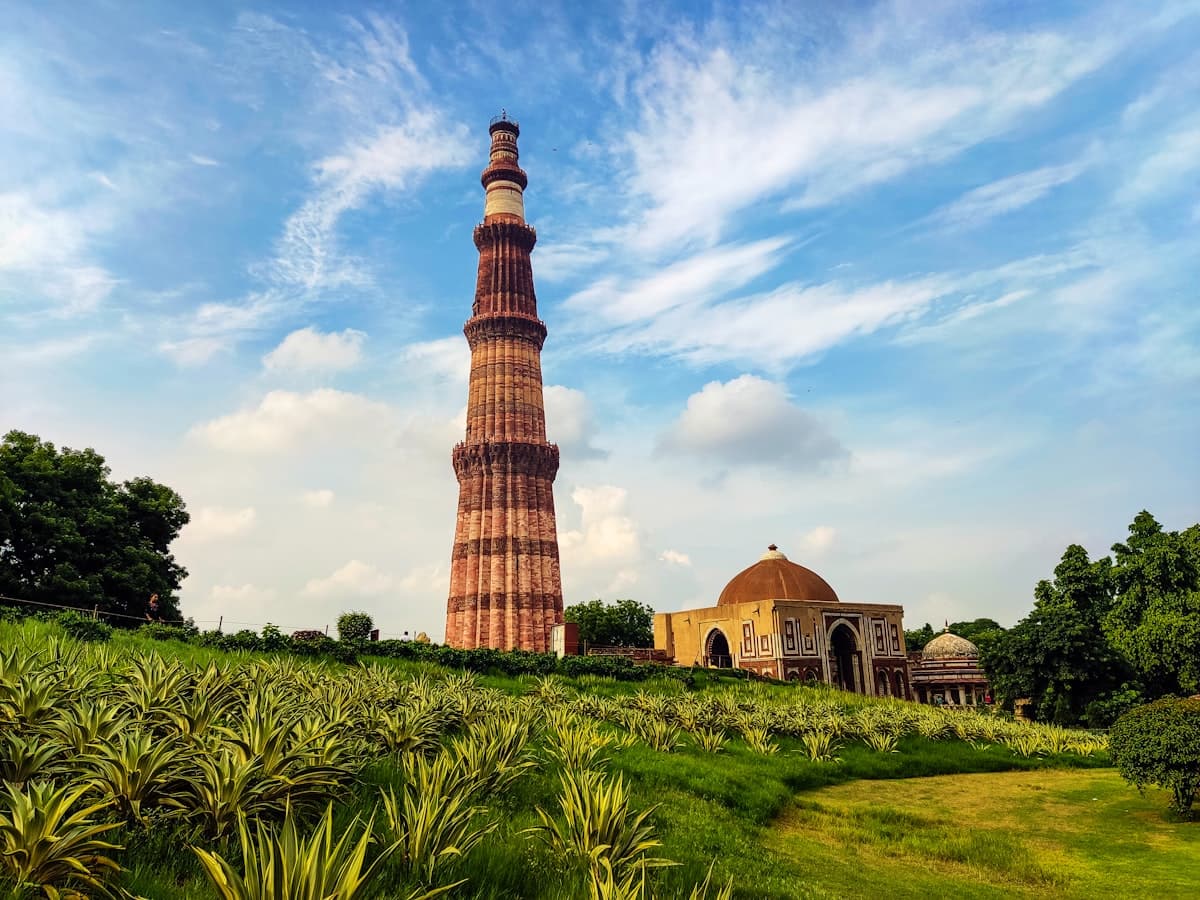
Qutub Minar is the tallest brick minaret in the world, and the first thing it does is make you look up. It rises 72.5 metres from a green park in Mehrauli, south Delhi. Five tapering storeys, bands of red sandstone and calligraphy, and a balcony at every level.
Everything around the tower, from the ruined mosque to the Alai Darwaza, belongs to the first centuries of the Delhi Sultanate, and the Iron Pillar is far older still. This guide gives you the facts first, then a route through the complex, then the best months and hours to go.
Figures were checked in October 2026. Fees and exact hours differ between sources, so the tables show ranges where they do. Confirm at the gate.
Qutub Minar at a glance
What to know | |
|---|---|
Where | Mehrauli, south Delhi. The nearest metro stop is Qutub Minar on the Yellow Line |
Hours | Daily, from about sunrise to sunset. Commonly listed as about 7:00 am to 5:00 pm, and some sources give longer summer hours |
Weekly closing day | None |
Time to allow | 1.5 to 2 hours |
Best hour | Opening time. The tower glows and the lawns are empty |
Best season | October to March |
Height | 72.5 metres, in five storeys |
Steps | 379 inside the shaft |
Can you climb it? | No. The interior has been closed to visitors since 1981 |
Heritage status | UNESCO World Heritage Site since 1993 |
Run by | The Archaeological Survey of India (ASI) |
A short history
Qutb-ud-din Aibak began the tower in 1192, soon after the Delhi Sultanate was founded. He completed only the first storey. His successor Iltutmish added more floors in the early 1200s. In 1368, Firoz Shah Tughlaq rebuilt the upper storeys after lightning damaged them. That is why the upper levels use marble as well as red sandstone.
The minaret was probably built as a victory tower and as a call to prayer for the neighbouring mosque. Its inscriptions in Arabic and Nagari tell the story, if you can read them. The surface is carved in bands of text, flowers and geometric patterns that are worth a close look.
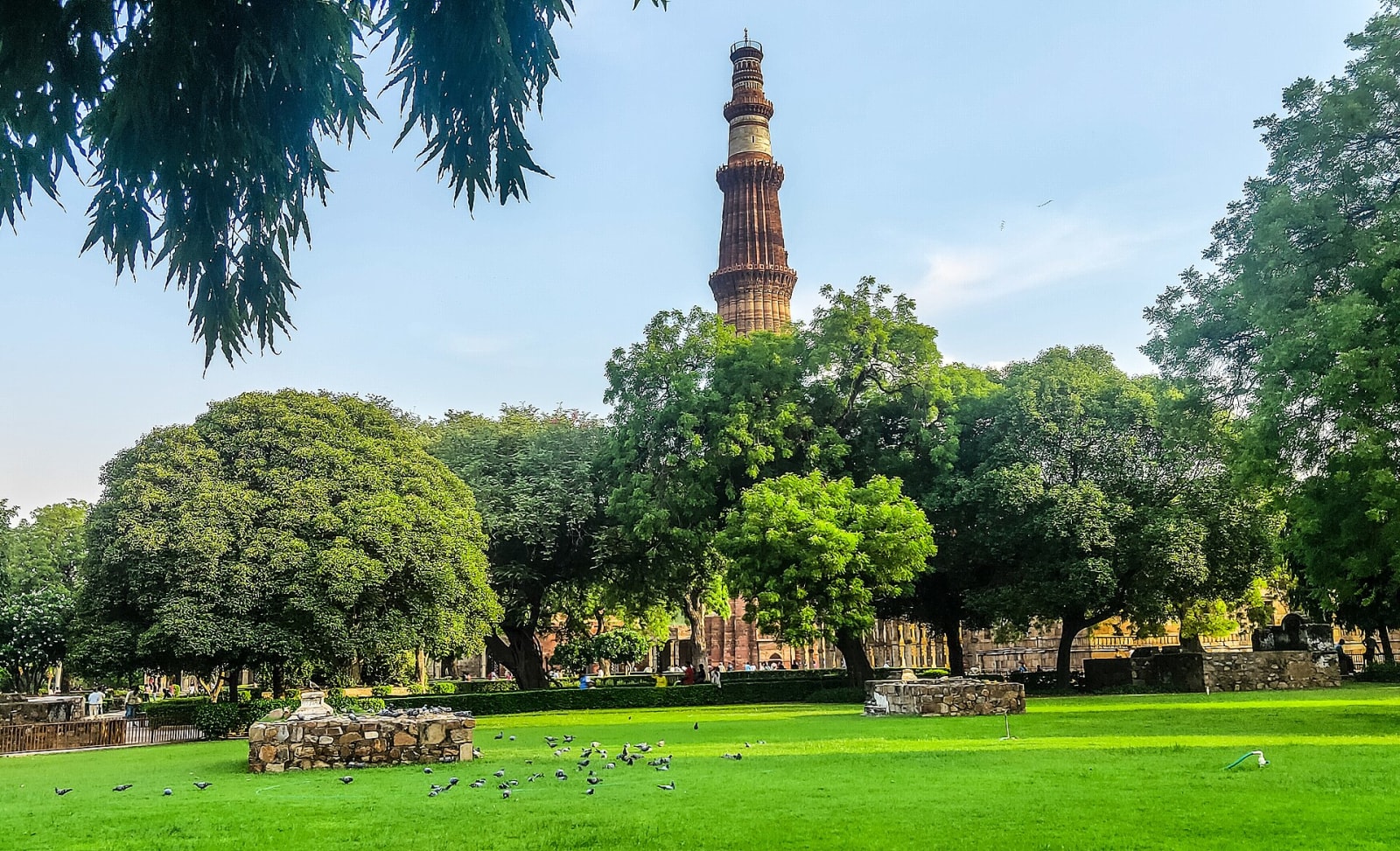
The minaret seen across the lawns of the complex.
Opening hours and tickets
Part | Hours | Notes |
|---|---|---|
Qutub Minar complex | About sunrise to sunset, daily | No weekly closing day |
Inside the tower | Closed | No climbing since 1981 |
After dark | Closed | Visitors cannot enter after closing time |
Ticket | Indian visitors | Foreign visitors |
|---|---|---|
Entry, online | About ₹35 | About ₹550 |
Entry, at the gate | About ₹40 to ₹50 | About ₹600 |
Children under 15 | Free | Free |
Camera | Small extra fee on some listings | Small extra fee on some listings |
The ASI sets these fees and revises them from time to time. Online tickets cost a little less than cash tickets and skip the queue. Weekends and public holidays are busy, so go early on a weekday if you can.
Why you cannot climb it
Until 1981 visitors could climb the 379 steps to the top. On one day that year a power failure plunged the narrow staircase into darkness and a crush followed. About 45 people died, many of them schoolchildren. The ASI closed the interior to the public soon afterwards, and it has stayed closed.
It is a sombre fact, and a guide will often mention it. It also changes how you see the tower. You look at it from outside, which is a good way to appreciate the carving.
The route through the complex
The grounds are laid out as a loop. Walk it in this order and you move from the oldest ruins to the grandest tower.
Stop | What it is | Allow |
|---|---|---|
Entrance and approach | The first view of the minaret across the lawns | 10 min |
Quwwat-ul-Islam mosque | Delhi's earliest surviving mosque, c. 1193 | 25 min |
Iron Pillar | A Gupta-era pillar, about 1,600 years old | 15 min |
Qutub Minar base | The carved bands, close up | 15 min |
Alai Darwaza | A domed gateway of 1311 | 15 min |
Alai Minar | An unfinished giant tower stump | 10 min |
Tomb of Iltutmish | A carved tomb of the early 1200s | 10 min |
The Quwwat-ul-Islam mosque
The mosque stands beside the tower, a courtyard of arches and columns. Many of the columns were taken from earlier Hindu and Jain temples, and you can see figures and ornament carved into the shafts. The great screen of arches, with Arabic calligraphy spread across the stone, was added later.
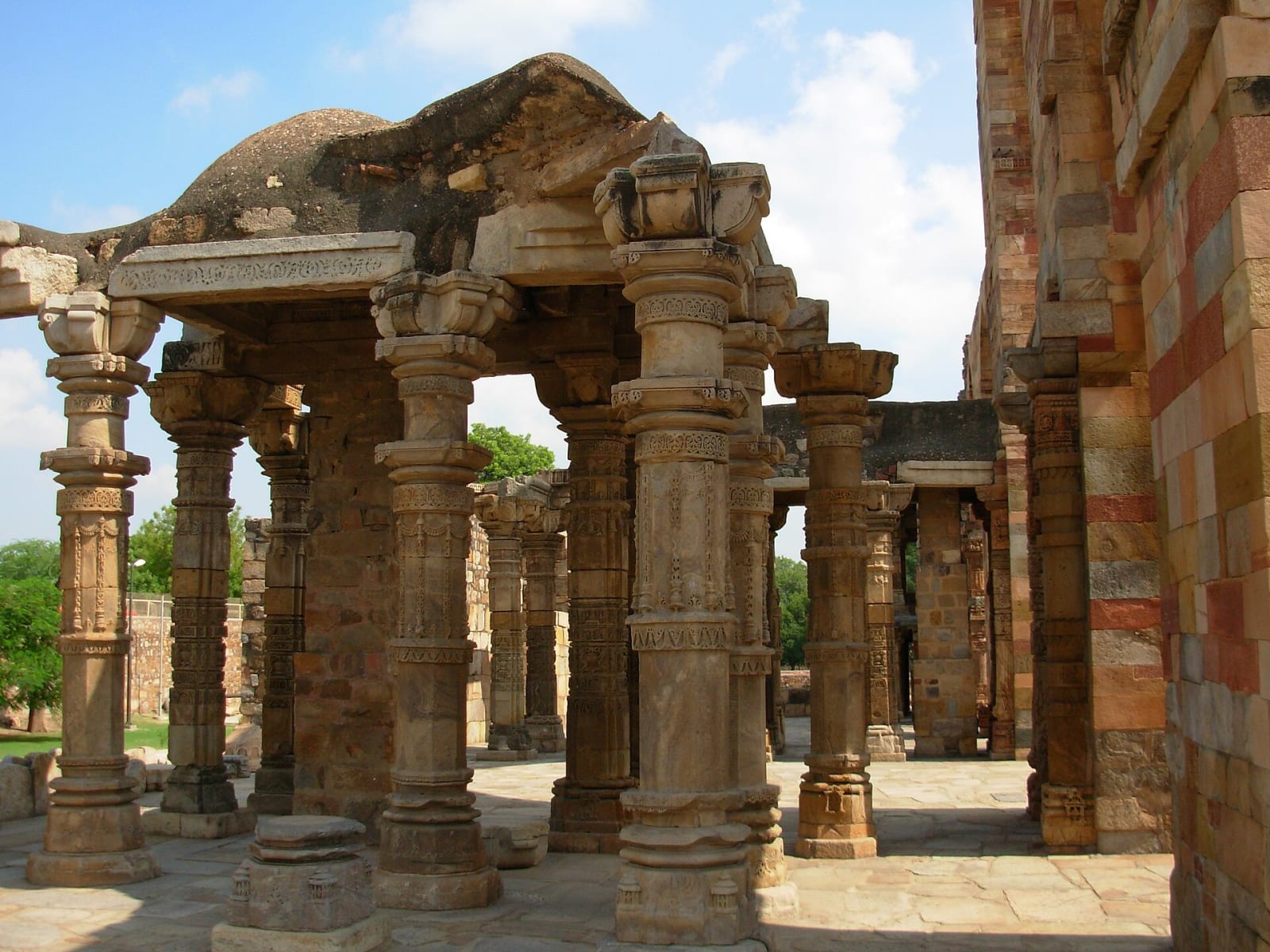
Carved pillars in the mosque, reused from earlier buildings.
The Iron Pillar
The Iron Pillar stands in the mosque courtyard. It is about seven metres tall and dates from the Gupta period, roughly the fourth or fifth century. It is made of very pure iron and has resisted rust for about 1,600 years, which has long fascinated metallurgists. Please do not lean against it or touch it. The railing is there to protect it.
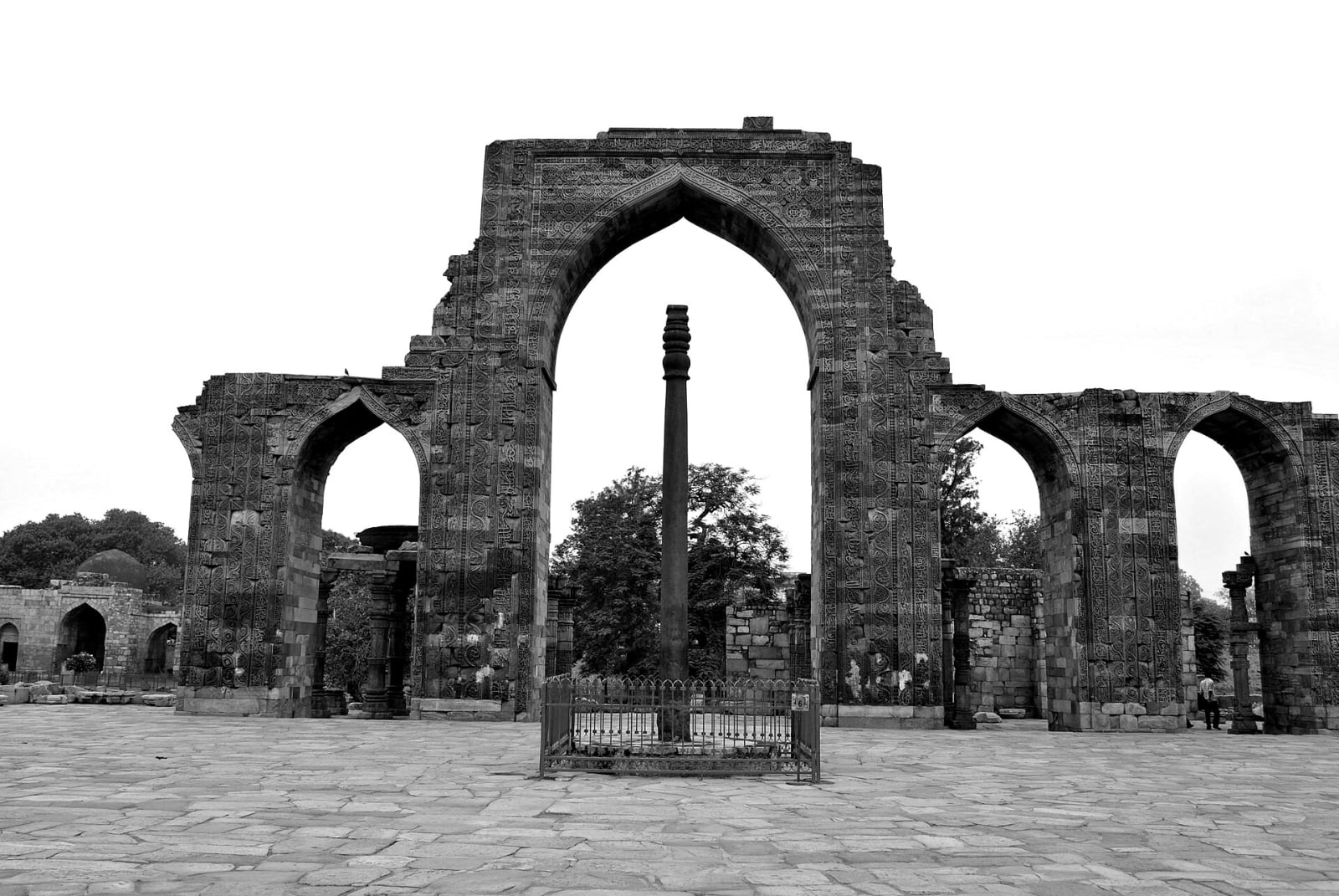
The Iron Pillar framed by an arch of the mosque.
Alai Darwaza and the unfinished tower
The Alai Darwaza, a domed gateway built by Alauddin Khalji in 1311, is the finest building in the complex after the minaret. Its red sandstone and white marble inlay, and its scalloped arches, are early examples of true Islamic arch and dome construction in India.
Alauddin also began a second tower, the Alai Minar, which was meant to be twice as tall as the Qutub Minar. He died before it was finished, and the unfinished base still stands.

Inside the Alai Darwaza, looking out to the gardens.
Best timing by month
Sunrise and sunset below are calculated for Delhi on the 15th of each month, in Indian Standard Time. Your visit window is roughly between them.
Month | Sunrise | Sunset | Visiting advice |
|---|---|---|---|
January | 7:14 am | 5:45 pm | Cold mornings, haze. Go mid-morning |
February | 7:00 am | 6:10 pm | Excellent. Clear and mild |
March | 6:32 am | 6:29 pm | Very pleasant. Go at opening |
April | 5:56 am | 6:46 pm | Warm by midday. Go early |
May | 5:30 am | 7:03 pm | Very hot. First hour only |
June | 5:22 am | 7:19 pm | Hot and dry, then humid |
July | 5:32 am | 7:21 pm | Monsoon. Green lawns, damp stone |
August | 5:50 am | 7:01 pm | Monsoon. Showers, fewer visitors |
September | 6:05 am | 6:27 pm | Warm, clearing |
October | 6:20 am | 5:52 pm | Good. Festival crowds from mid-month |
November | 6:43 am | 5:28 pm | Very good, though air quality can drop |
December | 7:06 am | 5:26 pm | Peak season. Cool, hazy mornings |
Delhi's air quality can fall sharply from late October through December. On poor days the tower disappears into haze, so check the forecast and keep the visit flexible.
Choosing your time of day
Time | What you get | Best for |
|---|---|---|
Opening | Soft light on the red sandstone, quiet paths | Photographers, first-timers |
Mid-morning | Tour groups arrive | Fine in winter |
Midday | Hard light, heat | Skip in summer |
Last hour | Warm light, thinning crowds | Couples, photographers |
Who Qutub Minar suits
Traveller | Why it works | Tip |
|---|---|---|
First-time visitors | The start of Delhi's medieval story | Combine with Humayun's Tomb |
History readers | Sultanate carving, reused temple pillars | Hire a guide |
Photographers | Red stone against sky, arches and lawns | Go at opening |
Families | Open lawns and room to run | Allow 90 minutes |
Architecture fans | Early mosque, Indo-Islamic arch and dome | Spend time in the Alai Darwaza |
What to pair it with
Qutub Minar sits in Mehrauli, one of Delhi's oldest neighbourhoods. A half-day here works well.
Mehrauli Archaeological Park is next door, with tombs, stepwells and mosques scattered through woodland. It is far quieter than the main complex.
Humayun's Tomb is a good contrast, calm and symmetrical. Read our Humayun's Tomb guide.
The Red Fort shows Delhi's Mughal chapter. See our Red Fort guide.
Old Delhi's food lanes make a good evening. Read our food walk guide.
How to plan your visit
Arrive at opening, especially on weekends.
Buy an online ticket if you want to skip the queue.
Do not plan to climb. The tower is closed inside.
Walk the loop in order, mosque, Iron Pillar, tower, Alai Darwaza.
Hire a guide for the inscriptions and the temple pillars.
Add Mehrauli Archaeological Park if you have another hour.
Where it fits in a Delhi trip
Qutub Minar suits a morning, and the afternoon can go to the tombs and the city. Our plan for two days in Delhi shows one way to combine them. For the wider picture, read our Golden Triangle highlights guide and how many days you need.
For a stay in central Delhi, The Oberoi, New Delhi and The Imperial are both well placed. See how Delhi fits into a route in the Golden Triangle Classic, 5 days itinerary or the First-Timer's Golden Triangle package.
Frequently asked questions
What are the Qutub Minar timings?
Daily, from about sunrise to sunset. Most listings give about 7:00 am to 5:00 pm. There is no weekly closing day.
How much is the Qutub Minar ticket?
About ₹35 to ₹50 for Indian visitors and about ₹550 to ₹600 for foreign visitors. Children under 15 enter free. Online tickets are slightly cheaper.
Can you climb the Qutub Minar?
No. The interior has been closed to visitors since 1981.
How tall is the Qutub Minar?
72.5 metres, with five storeys and 379 steps inside.
How long does Qutub Minar take?
About 1.5 to 2 hours for the complex. Add an hour for Mehrauli Archaeological Park.
What is the Iron Pillar?
A pillar about seven metres tall, made in the Gupta period, roughly the fourth or fifth century. It has stood for about 1,600 years without rusting.
Is Qutub Minar worth visiting?
Yes. It is the best place in Delhi to see the earliest Indo-Islamic building in India, and it is easy to combine with other sights.
Is Qutub Minar open at night?
No. The complex closes at sunset, and visitors cannot enter after dark.
Plan your Delhi visit with us
We time monument mornings around the light, the heat and the air quality. Explore the Golden Triangle destination page or talk to a trip designer.
Photo credits
Minaret across the lawns: Yashasvi Sangwan, CC BY-SA 4.0. Mosque pillars: chopr, CC BY 2.0. Iron Pillar and arch: Parth.rkt, CC BY-SA 3.0. Alai Darwaza: Indrajit Das, CC BY-SA 4.0. All via Wikimedia Commons.
Journeys for this trip
Plan your Golden Triangle trip
Read Next
All Stories →
Where to Stay on the Golden Triangle: Delhi, Agra and Jaipur
Vrindavan and Mathura Day Trip from Delhi or Agra: Temples and Timings