Mehrangarh Fort, Jodhpur: Timings, Tickets and a Gate-by-Gate Route
Mehrangarh Fort guide: opening hours, ticket prices, the seven gates, museum highlights, the zip line and how to pair the fort with Jaswant Thada.
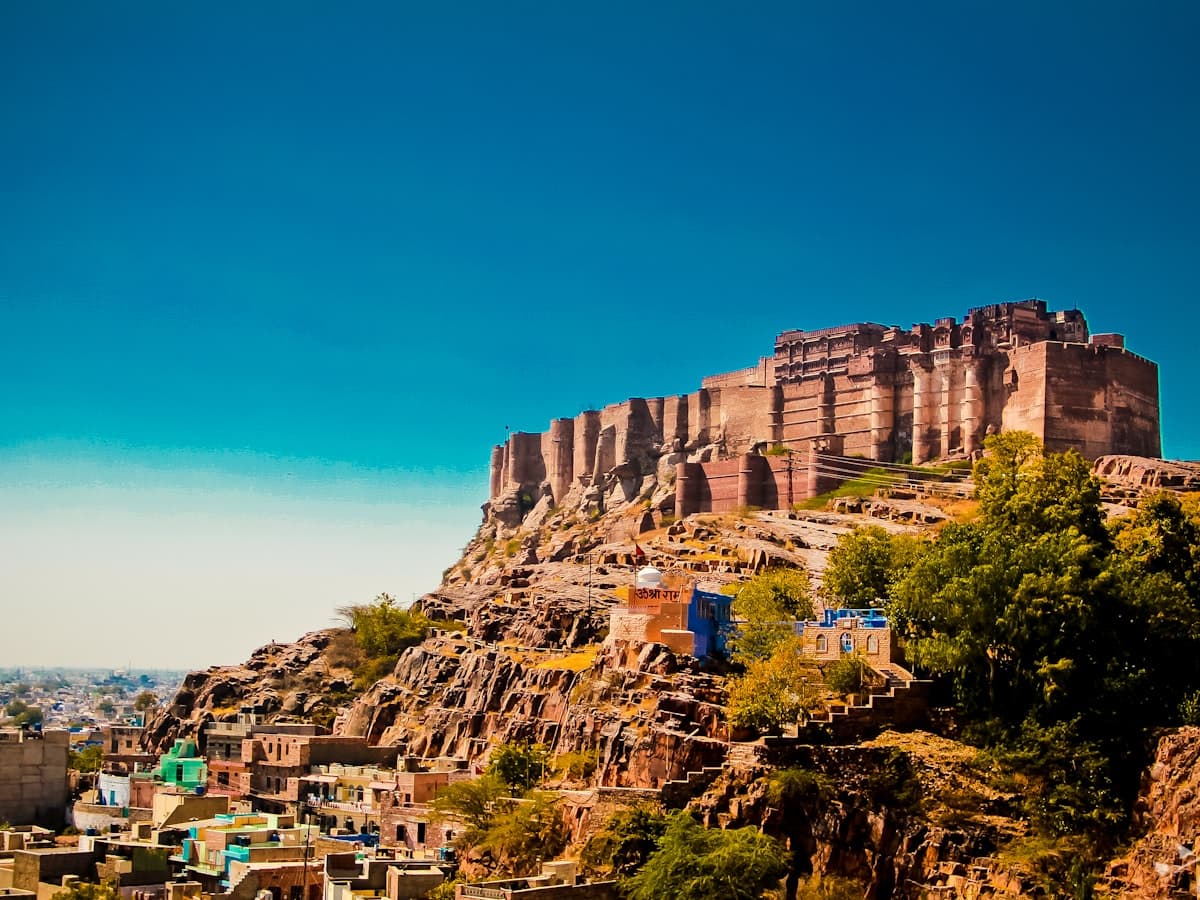
Mehrangarh does not sit on a hill so much as grow out of one. The walls rise straight off the rock, and from the parapet the old city spreads out below in flat blue rectangles. It is the fort many travellers remember longest.
It is also well run. There is a good museum, a lift for tired legs, and a gate sequence that tells a story if you walk it in order. This guide gives you the practical facts first, then a route, then what to pair it with.
Figures were checked in October 2026. Sources disagree on some prices, so the tables show ranges where they do. Confirm at the ticket office.
Mehrangarh at a glance
What to know | |
|---|---|
Where | On a rock above Jodhpur's old city, Rajasthan |
Museum hours | 9:00 am to 5:00 pm, open every day. Last entry is usually around 4:30 pm |
Time to allow | At least 3 hours. Add time for the temple and garden |
Best hour | Opening time for cooler air and fewer groups. Late afternoon for soft light over the city |
Best season | October to March. Summer afternoons are very hot |
Founded | 1459, by Rao Jodha. Most of what you see dates from the 17th century on |
Height | Rises roughly 120 metres above the plain. Walls up to about 36 metres high |
Run by | The Mehrangarh Museum Trust |
A short history
Rao Jodha, the Rathore ruler, laid the foundation on 12 May 1459. He chose a rocky ridge above the plain and built a new capital below it. Jodhpur takes its name from him.
Much of today's fort dates from the 1600s, when Maharaja Jaswant Singh and his successors added palaces, gates and courtyards. The result is a fort that was lived in, not only defended. The palaces inside are named for what they held: Moti Mahal, the Pearl Palace, Phool Mahal, the Flower Palace, and Sheesh Mahal, the Mirror Palace.
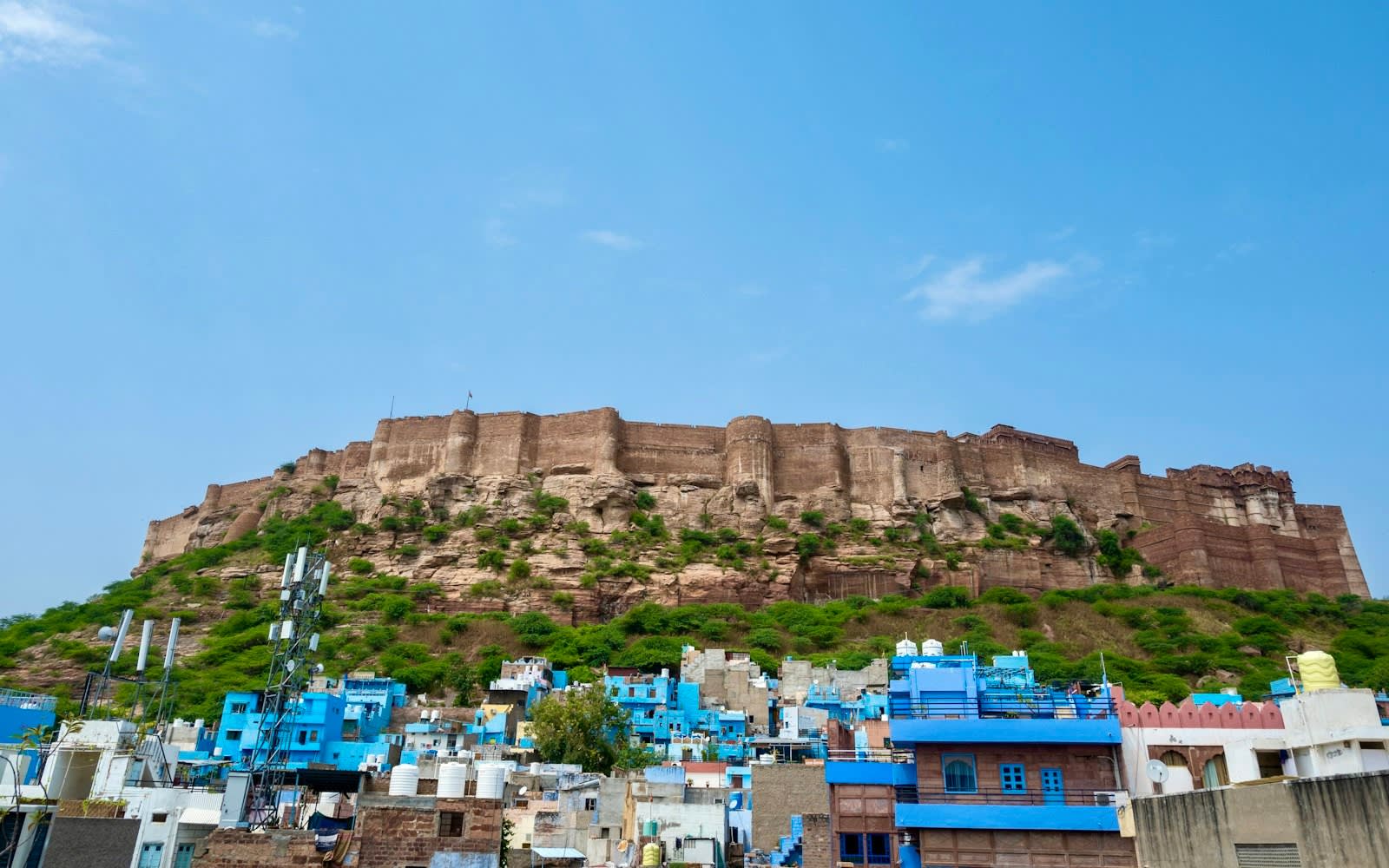
The fort above the blue houses of the old city.
Opening hours and tickets
Place | Hours | Notes |
|---|---|---|
Mehrangarh Museum | 9:00 am to 5:00 pm | Open every day. Included in the fort ticket |
Jaswant Thada | 9:00 am to 5:00 pm | The white marble memorial below the fort. Separate entry |
Chokhelao Garden | 9:00 am to 5:00 pm | A restored 18th-century garden |
Rao Jodha Desert Rock Park | Apr to Sep: 7:00 am to 6:30 pm. Oct to Mar: 8:00 am to 5:30 pm | A restored desert landscape beside the fort |
Ticket | Indian visitors | Foreign visitors |
|---|---|---|
Fort and museum entry | About ₹100 to ₹200 | About ₹600 to ₹800 |
Audio guide | Often included in the foreign ticket. Extra if bought separately | Included in most listings |
Lift to the upper levels | Small extra fee | Small extra fee |
Sources disagree on the exact prices, which are revised from time to time. The Mehrangarh Museum Trust sells tickets online, and booking ahead saves a queue. Hours above are the Trust's own.
The route through the fort
The approach is a climb through a series of gates, each with its own story. Follow them in order and the fort explains itself.
Stop | What it is | Allow |
|---|---|---|
Jai Pol | The main entrance, built in 1806 by Maharaja Man Singh to mark his victories | 10 min |
Fateh Pol | A gate celebrating a victory over the Mughals in 1707 | 5 min |
Dedh Kamgra Pol | A gate that still shows scars from cannon fire | 5 min |
Loha Pol | The Iron Gate, with the handprints of royal women on its wall | 10 min |
The palaces | Moti Mahal, Phool Mahal, Sheesh Mahal and more | 90 min |
The museum galleries | Howdahs, palanquins, arms, paintings, textiles | 60 min |
The ramparts and cannons | Views over the blue city | 20 min |
Chamunda Mataji Temple | At the far end of the fort | 20 min |
The gates
The gates are worth slowing down for. The Jai Pol is the grand entrance. A little higher, the Dedh Kamgra Pol still carries the marks of cannonballs.
At the Loha Pol, the Iron Gate, you will see a row of small handprints in the wall. They were left by royal women before they died on a maharaja's funeral pyre, a practice known as sati and long since outlawed. Look at them with respect. Many visitors find them the most moving thing in the fort.
The palaces and galleries
The palaces are rich in mirror work, gilding and painted ceilings. Many windows are carved stone screens, a feature that let the women of the court watch events without being seen.
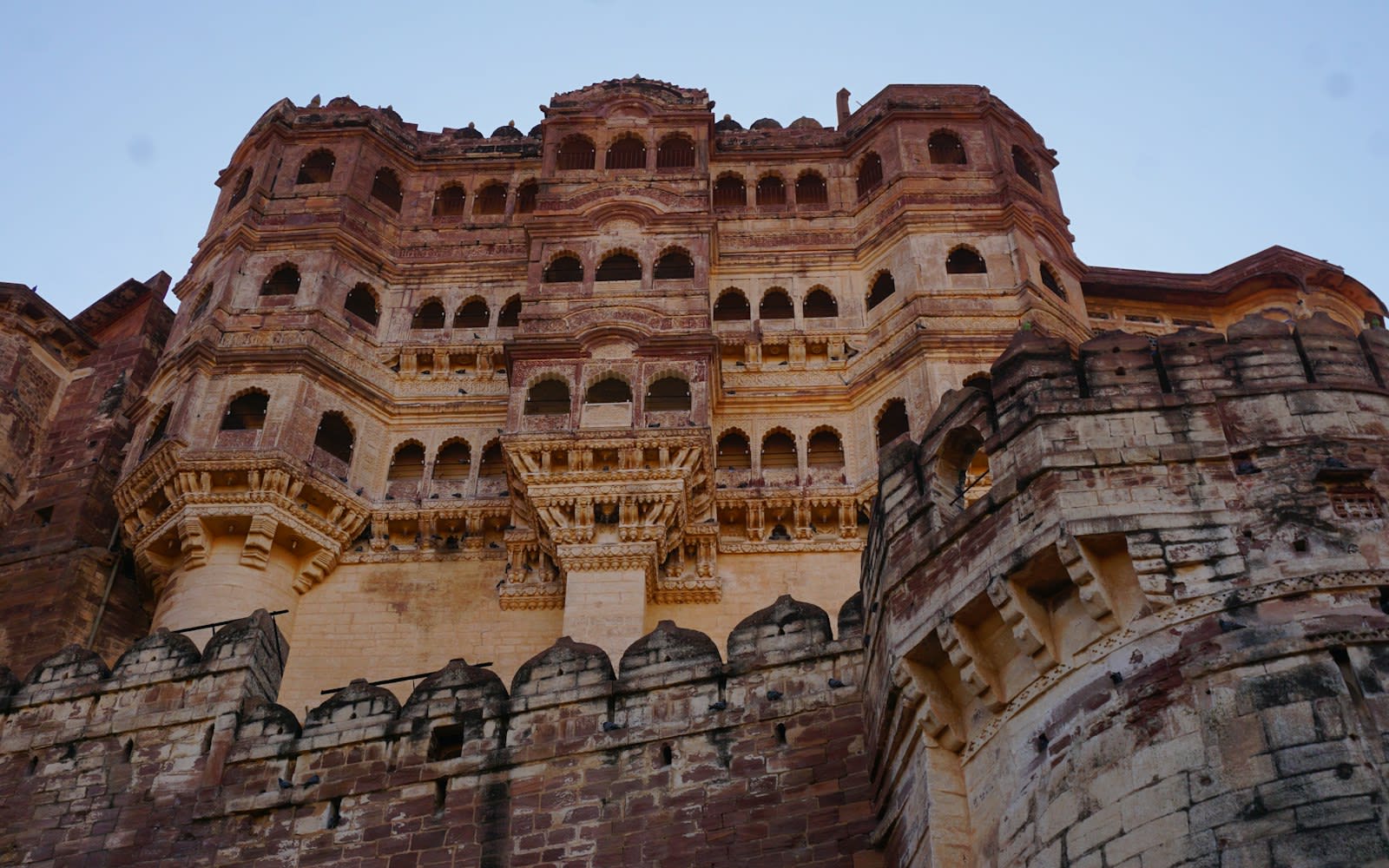
The carved palace facade, seen from below the ramparts.
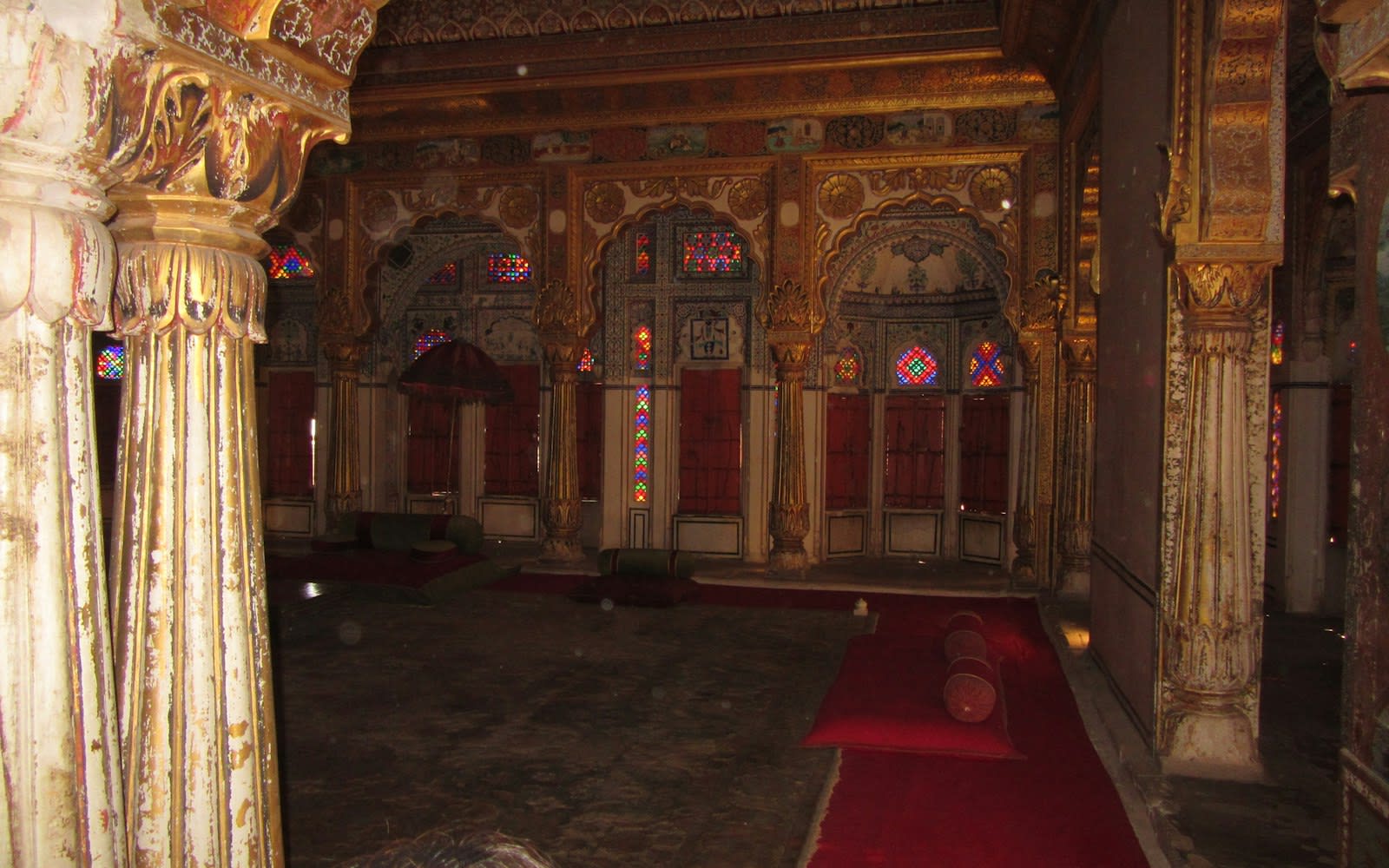
A pillared hall inside the fort. Painted and gilded ceilings reward a long look.
The museum holds an unusually good collection. You will see howdahs and palanquins, royal cradles, musical instruments and costumes. There is a turban gallery, a gallery of Marwar-Jodhpur miniature paintings, and an armoury with swords said to have belonged to emperors, as well as a Rathore ancestral sword weighing over three kilograms.
Take the audio guide. It turns a collection into a story.
Chamunda Mataji Temple
At the far end of the fort is the Chamunda Mataji Temple. The goddess was brought here from Mandore in 1460 and remains the royal family's chosen deity. It is a working temple. At Dussehra it draws very large crowds. Remove your shoes and be quiet.
A word on the lift and the walking
The fort is built on a steep rock, and the museum spreads over many levels. A lift takes you to the upper levels, so you do not have to climb everything. If you have limited mobility, use it, and ask the staff about the easiest route.
Wear shoes with grip. The stone is polished by centuries of feet.
Who Mehrangarh suits
Traveller | Why it works | Tip |
|---|---|---|
First-time visitors | A well-presented fort with strong interpretation | Take the audio guide and allow three hours |
Photographers | Blue-city views, carved facades and deep shade | Go early, and shoot the facade from the ramparts |
History readers | Rathore history, a rich museum and a clear gate sequence | Ask a guide about the 1707 and 1806 victories |
Families | Cannons, ramparts and a lift for small legs | Keep the museum visit shorter for young children |
Couples | Evening light over the old city | Finish with sunset from the ramparts or a rooftop |
Adventure seekers | A zip line across the fort's rock | Book separately, as below |
The zip line
A separate operator, Flying Fox, runs a zip-line course over the fort's rocks and walls. It is a ticketed activity, booked apart from the fort entry. The tour takes about 90 minutes, with six zip lines of between 70 and 300 metres. Prices start from roughly ₹1,700 online. Check the current price and book ahead.
What to pair it with
Mehrangarh takes a morning. These stops fill out the day.
Jaswant Thada is a white marble memorial just below the fort. The view of the fort from here is one of the classic photographs of Jodhpur.
The old city and Sardar Market are a short drive away. Sardar Market is a working bazaar around a clock tower. Ask for makhaniya lassi and you will be pointed to the right stall. Go in the late afternoon.
Umaid Bhawan Palace is part palace, part hotel and part museum. Our guide to Rajasthan's heritage hotels explains what staying in one is like.
Rao Jodha Desert Rock Park is a restored desert landscape beside the fort, good for a quiet walk.

The fort on its hill, seen from near Jaswant Thada.
How to plan your visit
Book tickets online if you can, and arrive at 9:00 am.
Allow three hours, and more if you want the temple and the garden.
Use the audio guide. It adds a great deal.
Walk the gates in order. The sequence is the point.
Wear shoes with grip and carry water.
End on the ramparts. The view over the blue city is the reward.
Where Jodhpur fits in Rajasthan
Jodhpur usually sits between Jaipur and Udaipur, or between Jaisalmer and Udaipur. If you are still deciding the order, read our guide to choosing your Rajasthan city order. For the whole state, see the best places to visit in Rajasthan. If the desert is next, our Jaisalmer fort and desert camp guide picks up from here.
For somewhere to stay in the city, RAAS Jodhpur and Ajit Bhawan are both close to the old town.
To see Jodhpur in a built route, look at Rajasthan Desert Forts, 6 days or the Rajasthan Royal Heritage package.
Frequently asked questions
What are Mehrangarh Fort's opening hours?
The museum is open from 9:00 am to 5:00 pm every day. The last entry is usually around 4:30 pm.
How much is the Mehrangarh Fort ticket?
Roughly ₹100 to ₹200 for Indian visitors and ₹600 to ₹800 for foreign visitors, depending on the source and year. The foreign ticket usually includes an audio guide. Confirm at the ticket office or online.
How long does Mehrangarh Fort take?
Allow at least three hours. Add time if you want the temple, the garden or the rock park.
What is the best time to visit Mehrangarh?
Arrive at 9:00 am for cooler air and smaller crowds. Late afternoon gives soft light over the city. October to March is the comfortable season.
Is there a lift?
Yes. A lift runs to the upper levels for a small extra fee, which helps visitors who find the climb hard.
Can I zip-line at Mehrangarh?
Yes, through a separate operator called Flying Fox. It is booked and priced separately from the fort ticket.
What are the sati handprints?
They are small handprints on the wall of the Loha Pol, left by royal women before they died on a maharaja's funeral pyre. The practice has long been outlawed. Visitors should view them respectfully.
Plan your visit with us
We time Jodhpur around the light, the lift and the right guide. Browse the Rajasthan destination page or talk to a trip designer.
Read Next
All Stories →Places to Visit in Rajasthan: Forts, Palaces, Lakes and Markets, and Who Each Suits
Amber Fort, Jaipur: Timings, Tickets and How to See It Properly