Fatehpur Sikri: The Best Stop Between Agra and Jaipur
Why Akbar's abandoned capital is worth the pause on the Agra to Jaipur drive, and how to see it well without losing half your day.
The drive from Agra to Jaipur takes about five hours. Most of it is unremarkable highway, and most travellers sleep through it. One stop, about forty minutes outside Agra, is worth waking up for.
What Fatehpur Sikri actually is
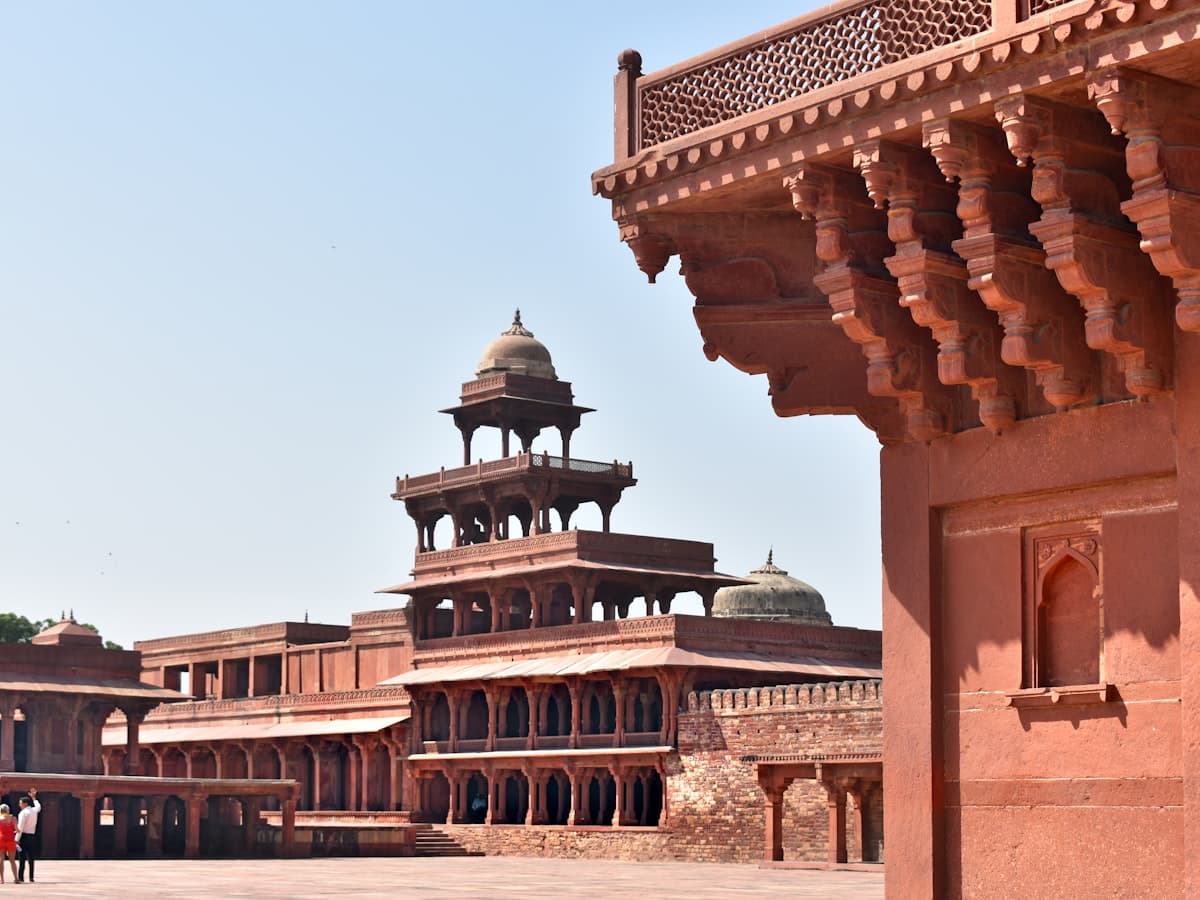
Fatehpur Sikri was the Mughal empire's capital for barely fifteen years. Akbar built it from red sandstone in the 1570s, then abandoned it, most likely because its water supply failed. What is left is a near-complete Mughal city, deserted rather than ruined, which is a stranger and more atmospheric thing to walk through than a restored monument.
The highlights sit close together inside the complex:
Buland Darwaza, a 54-metre gateway built to mark a military victory, and one of the largest gates in the world.
Jama Masjid, Fatehpur Sikri's own mosque, still active and separate from the more famous one in Delhi.
The Tomb of Salim Chishti, a white marble shrine inside the mosque courtyard, where visitors still tie threads for wishes.
Panch Mahal, a five-storey pavilion of diminishing open terraces, built for the women of the court to take the air.

How to see it without losing your day
Budget sixty to ninety minutes. That is enough to see all four sites above at an unhurried pace, without turning a half-day stop into a full one.
A few practical notes make this smoother:
Shoes come off at the mosque and tomb, as at any working mosque. Wear socks, or expect hot stone underfoot at midday.
A local guide at the gate is worth hiring. Fatehpur Sikri has almost no signage, and its story does not read itself from the architecture alone.
Ignore anyone offering a "shortcut" tour of the bazaar first. The direct route to the complex is well marked from the car park; detours cost time, not money.
Why Akbar left after only fifteen years
The abandonment is part of what makes Fatehpur Sikri worth seeing. Akbar built the city in the 1570s as a purpose-made capital, complete with palaces, a mint and a full administrative court, reportedly to honour the Sufi saint Salim Chishti, who had predicted the birth of his son here. Within fifteen years the court moved back to Agra, most likely because the surrounding land could not supply the new capital with enough water year-round. What survives is essentially a full Mughal city frozen mid-use rather than rebuilt or repurposed, which is rare — most Mughal sites of this scale kept evolving under later rulers.
The second option: Chand Baori
Travellers with extra time sometimes add a detour to the stepwell at Abhaneri, commonly called Chand Baori: a 9th-century well dug more than thirteen storeys down in a repeating geometric pattern. It is dramatic in photographs, but it sits off the direct Agra–Jaipur highway, adding roughly ninety minutes each way. Treat it as a bonus for photographers with a flexible schedule, not a standard stop — most of our itineraries route through Fatehpur Sikri alone, and add Abhaneri only on request.
What to skip
A few things are worth knowing before you arrive.
Skip the "official guide" touts at the car park. Legitimate guides carry ASI (Archaeological Survey of India) identification and are best booked through your trip designer in advance, not selected on the spot.
Skip the elephant rides sometimes offered near the entrance. They are unrelated to the monument, not part of any official experience, and worth avoiding on welfare grounds alone.
Skip visiting in the early afternoon in summer. The sandstone courtyards hold heat, and shoes-off areas become genuinely uncomfortable underfoot by midday from March through June.
Which itineraries already include it
Fatehpur Sikri is built into the drive on most of our Golden Triangle routes, not offered as an optional extra: the 4-Day Classic, 5-Day Classic, 6-Day Classic and 7-Day In-Depth all take the same route between Agra and Jaipur and stop here on the way. If you are still weighing up trip length, see our full comparison of how many days the Golden Triangle needs.
Travellers extending into Rajasthan's wildlife can pair this stop with a further leg south on our Golden Triangle with Ranthambore route.
Where to base yourself the night before
Leaving Agra early makes the stop far more comfortable, since Fatehpur Sikri gets hot and crowded by midday. The Oberoi Amarvilas and Trident, Agra both put you close to the Agra–Jaipur road, so an early checkout loses no time.
Frequently asked questions
Is Fatehpur Sikri worth visiting?
Yes, especially since it sits directly on the Agra–Jaipur route rather than requiring a separate trip. An hour here adds real depth to the drive at very little cost in time.
How far is Fatehpur Sikri from Agra and Jaipur?
About 40 minutes from Agra and just over four hours from Jaipur, allowing for the stop itself.
Is Chand Baori on the way to Jaipur?
Not directly. It is a detour off the main highway, so it suits travellers with a flexible day rather than a fixed arrival time in Jaipur.
Do I need a guide inside Fatehpur Sikri?
It is not required, but strongly recommended. The site has very little on-site signage explaining what you are looking at.
Plan the drive properly
Browse our Golden Triangle destination page for full route options, or start with the First-Timer's Golden Triangle package. To build in extra stops like Chand Baori, talk to a trip designer.
Read Next
All Stories →
Old Delhi Through Its Food: A First-Timer's Walking Guide
How Many Days Do You Really Need for the Golden Triangle?